

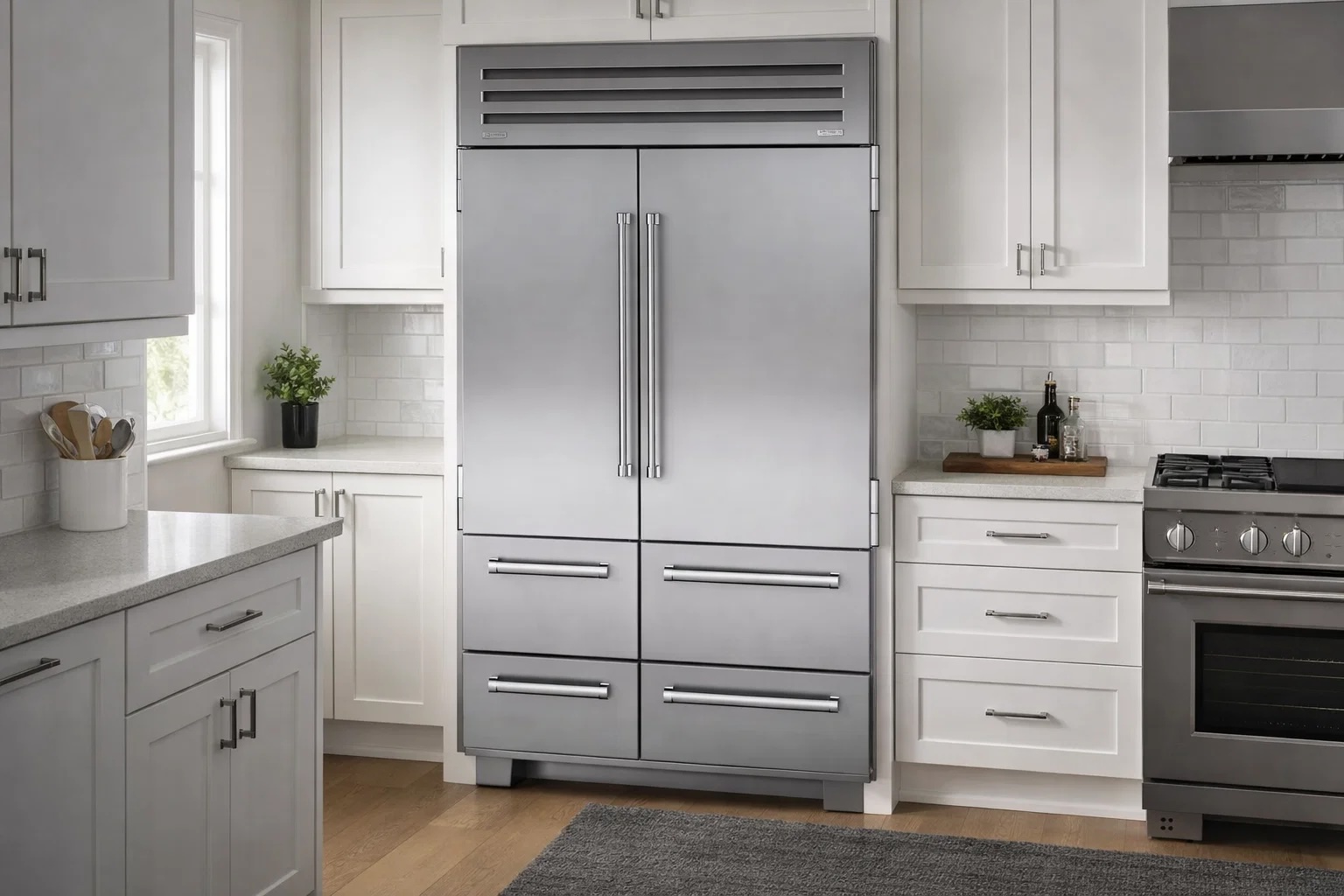
Sub-Zero refrigerators are engineered differently from almost every other brand on the market. Most premium and classic models (500, 550, 590, 600 Series, and Designer columns) use a dual-compressor system — one dedicated compressor for the refrigerator section and a separate one for the freezer. The flagship Pro Series models like the PRO3650 and 648PRO take it even further with heavy-duty commercial-grade compressors wrapped in extra sound insulation. The result? These units are among the quietest luxury refrigerators available, often running at a barely audible soft hum that blends into everyday kitchen noise.
The compressor itself is the heart of the cooling system: it pressurizes and circulates refrigerant through the coils to remove heat. Sub-Zero designs these compressors — and the cabinets around them — with a strong focus on low-decibel operation. Sub-Zero’s published documentation normal operating sound levels in the 38 – 45 dB range (about the volume of a quiet library), which is why most owners never notice the unit running at all.
That said, we get calls every week from Atlanta-area homeowners asking “why is my fridge so loud all of a sudden?” or “why is my fridge making noise it never made before?” In many cases, especially with newer installations of classic models like the 550 or 561, the sound is just the normal startup surge or defrost cycle that the owner simply hadn’t noticed until the house got quiet. Our technicians see this in roughly 30% of first-time service requests — perfectly healthy compressors doing exactly what they’re supposed to do.
But when the sound changes — becomes louder, sharper, or constant — it can point straight to the compressor or related components. And because a genuine Sub-Zero compressor assembly is one of the most expensive parts in the appliance (often several thousand dollars installed), catching compressor noise problems early can save you from a complete breakdown and spoiled food.
In this guide, the Sub-Zero Techs team in Atlanta will walk you through exactly which sounds are normal, which ones are red flags, and step-by-step compressor noise troubleshooting you can do yourself — plus when it’s time to call us before the problem gets worse. Let’s quiet things down the right way. Not sure whether it is worth a service call? Check Johns Creek repair service for what we look at on arrival.
Noises from Your Sub-Zero Compressor That Should Never Be Ignored
A properly running Sub-Zero compressor makes a steady, low hum that starts softly, runs for a while, then shuts off quietly. Anything dramatically different from that pattern usually means something is wrong. Over the years, our Atlanta technicians have heard every variation, and these are the seven sounds that almost always lead to a service call when they show up.
#1 Humming noise that gets progressively louder or never fully quiets down
A healthy compressor hum is consistent and low. If the humming noise starts normal but builds to the point you can hear it in the next room (especially on 500 Series models like the 511, 550, or 590), the bearings inside the compressor are usually beginning to fail or the unit is severely overworking due to dirty coils.
#2 Buzzing sound from the back or base of the unit
This is one of the most common complaints on Designer column models (DEC1850FI, DEC1850W) and the 600 Series. A sharp electrical-type buzzing sound from the compressor area almost always means the start relay is failing or there’s loose electrical wiring making intermittent contact.
#3 Compressor vibration in fridge that shakes the whole cabinet or nearby items
Excessive compressor vibration in fridge is classic on the PRO4850 and 648PRO when the rubber mounting grommets harden or crack over time. You’ll feel it in the floor and hear panels or bottles rattling inside — left alone, it eventually loosens tubing and causes refrigerant leaks.
#4 Fan noise in refrigerator that sounds like it’s coming from the compressor
Many owners mistake evaporator or condenser fan issues for compressor problems. On dual-compressor models (561, 650, 661, 700 Series), a sudden high-pitched whine or fan noise in refrigerator that runs constantly usually means ice buildup or debris hitting the fan blade — but it puts extra load on the compressor and shortens its life.
#5 Refrigerator grinding noise on startup or shutdown
A brief “whoosh” is normal, but an actual metal-on-metal refrigerator grinding noise — especially on older 550, 590, or 661 units — almost always means the compressor’s internal pistons or valves are seizing. This is one of the fastest ways to kill a compressor completely.
#6 Compressor clicking sounds every few minutes without the motor actually running
Rapid compressor clicking sounds (click-click-click) that repeat for more than 30–45 seconds mean the start relay or overload protector is bad. We see this constantly on 550 and 661 models after power surges or outages — the compressor is trying to start but can’t.
#7 Rattling that seems to come from inside the back panel
Loose copper tubing, a displaced condenser fan shroud, or broken compressor mounting clips all create rattling. It’s especially noticeable on the PRO3650 and 648PRO because the cabinet is so heavily insulated — any loose part vibrates loudly against the steel shell.
If you’re hearing any of these, don’t just turn up the TV. The compressor is trying to tell you something before it fails completely. The next sections will help you decide whether it’s still safe to wait or time to act fast.
When You Can Safely Ignore the Noise
Sub-Zero builds some of the quietest refrigerators in the industry. Official Sub zero noise ratings typically fall between 38 and 45 dB — quieter than a normal conversation. The Pro Series noise levels, especially on the PRO3650, are even lower thanks to extra insulation and commercial-grade variable-speed compressors.
In our experience, a PRO3650 normal noise level is a soft, steady hum that you only notice when the house is dead silent, followed by a gentle click-off. Short whooshes during defrost, a brief surge at startup, or occasional light gurgling from refrigerant are all factory-intended sounds. If the temperature inside stays perfect and the sound hasn’t changed in volume or pattern, you’re almost certainly fine.
When to worry about noise

The red flags are simple: the sound is new, louder, or happening at the wrong time. A constant or escalating humming sound that wasn’t there last month, a clicking compressor that repeats every few minutes without the motor ever running smoothly, or a sudden loud humming refrigerator that vibrates the floor — these are the patterns our technicians see right before a compressor fails. If the noise wakes you up at night or you can hear it clearly from the next room, treat it as a warning.
What Happens If You Ignore Compressor Noise Issues
At Sub-Zero Techs in Atlanta, we’ve seen the exact same story play out hundreds of times: a strange noise starts, the owner hopes it “goes away on its own,” and three to six months later we’re hauling out a dead compressor and the customer is facing a five-figure repair bill plus a refrigerator full of spoiled food.
Ignoring abnormal compressor noise never ends well. The compressor doesn’t heal itself — it only gets worse until it finally locks up, leaks refrigerant, or trips internal safety cutouts. Once that happens, you lose cooling completely, energy bills skyrocket, and secondary damage (burned wiring, failed relays, cracked tubing) starts piling up.
Here’s exactly what our service records show happens when the most common noise issues are left unchecked — broken down by the models we repair most often in the Atlanta area:
Model / Series | Typical Ignored Noise | What Actually Breaks First | Real-World Complications We See |
511 (Classic 500 Series) | Escalating humming noise | Compressor bearings seize → 511 not cooling | Complete compressor failure, refrigerant leak, spoiled food |
550 / 561 (500–600 Series) | Repeated compressor clicking sounds | Start relay + overload burn out → 550 not cooling | Electrical shorts, possible control board damage, emergency no-cool calls at night |
590 / 595 (500 Series side-by-side) | Refrigerator grinding noise on start | Internal valve or piston failure | 590 not cooling, freezer warms first, ice cream ruined, compressor replacement mandatory |
661 (600 Series built-in) | Vibration + rattling from back | Mounts break → copper lines fracture | 661 not cooling, slow refrigerant leak, mold from uneven temps, cabinet damage |
648PRO (Pro Series) | 648PRO compressor grinding + vibration | Commercial compressor locks up | 648pro not cooling, both zones fail, $8,000+ parts/labor, weeks of downtime |
PRO4850 (current Pro) | PRO4850 loud noise at startup/surge | Over-stressed variable-speed inverter board | Sudden total shutdown, warranty claims denied if vibration damage is evident |
PRO3650 (36″ Pro) | Excessive buzzing or panel rattle | Insulation shifts → mounts crack | Gradual efficiency loss → skyrocketing electric bill → eventual compressor burnout |
DEC1850FI / DEC1850W (Designer columns) | Buzzing sound from base + clicking | Start components fail in tight column space | One column stops cooling while the other still runs, uneven food temps, ice maker failure |
Bottom line from fifteen years of Atlanta service calls: every single one of these scenarios started with a noise the owner decided to “live with for now.” By the time the unit finally stops cooling, the repair cost has usually doubled or tripled — and in some cases the damage is so extensive that customers end up replacing the entire appliance.
Don’t let that be you. The moment the noise changes from “background hum” to anything on the list above, you’re on borrowed time.
How to Fix a Noisy Sub-Zero Compressor: Step-by-Step
Not every loud compressor means an immediate thousand-dollar repair. Our Atlanta techs fix plenty of noise complaints with a 15-minute house call. Here’s exactly what we do — and what you can safely try first.
DIY Tips You Can Do This Weekend
- Level the unit perfectly – Even a 1/4-inch tilt causes compressor vibration in fridge and makes every sound louder. Place a bubble level on top, adjust the front rollers, and recheck side-to-side. Fixed more PRO3650 and 648PRO rattles this way than we can count.
- Clean the condenser coils – Dust-covered coils force the compressor to run longer and louder. Unplug the unit, pull it out (or remove the kick plate on built-ins), and vacuum the coils gently. This alone quiets troubleshooting humming in 500 and 600 Series models in about 70% of cases.
- Check for loose panels or items touching the back – A single loose screw on the rear grille can create rattling that sounds exactly like compressor failure. Tighten everything you can reach without removing sealed panels.
- Clear ice buildup around the evaporator fan – If you hear fan noise in refrigerator mixed with the compressor sound, open the freezer and look for frost blocking the fan. A quick manual defrost (unplug for 6–8 hours) often stops the noise instantly.
When to Call a Professional

If the noise continues after the steps above — or if you hear refrigerator grinding noise, repeated compressor clicking sounds, or the unit isn’t holding temperature — stop troubleshooting yourself. These almost always mean:
- Failing start relay or capacitor;
- Worn compressor mounts or internal bearings;
- Refrigerant restrictions or electrical faults.
DIY attempts beyond cleaning and leveling risk voiding your warranty and turning a $1200 repair into a $7,000 compressor replacement.
Our trained technicians carry relays, capacitors, and mount kits on the truck, so most fixing loud refrigerator compressor jobs are done the same day. We’ve been the go-to team for repair loud unit issues across Atlanta for over 15 years. Local help for this exact issue is available – see Sub-Zero service in Marietta.
FAQ
My Sub-Zero 648PRO makes a brief grinding sound only when it first starts up in the morning. Is this an emergency?
A brief startup grinding noise on a 648PRO is a major red flag, but not always a same-day emergency. In our experience, this almost always indicates the commercial-grade compressor’s internal components are beginning to wear or the start relay is failing. While the unit may still cool for weeks, compressor grinding under load is a progressive failure. We recommend scheduling a diagnostic visit within days, not months, to prevent a complete lockup that leads to 648PRO not cooling.
What’s the difference between a normal compressor hum and a problematic humming sound in my Sub-Zero?
The normal humming noise is soft, steady, and cyclical — it runs for a set period and shuts off cleanly. A problematic humming sound is often louder, may fluctuate in pitch, and sometimes never fully shuts off, becoming a constant background drone. The key indicator is change: if the hum is new, has grown louder over time, or is constant, it points to a compressor working under duress, often due to failing bearings or a refrigerant issue.
I cleaned the condenser coils, but my Sub-Zero 550 is still making a loud buzzing sound. What’s next?
Cleaning the coils is a great first step for general compressor noise troubleshooting. If a pronounced buzzing sound from the back persists, the issue is almost certainly electrical. For 550 models, the most common culprit is a failing start relay or a faulty overload protector. These components are located near the compressor and can be tested and replaced by a technician. Continuing to run the unit with this fault can lead to 550 not cooling as the compressor struggles to start.
Are unusual compressor clicking sounds ever normal?
A single, soft click when the compressor starts or stops is normal — it’s the relay engaging. Abnormal compressor clicking sounds are rapid (click-click-click), repetitive, and occur without the compressor motor successfully starting and running. This pattern indicates the compressor is trying but failing to start, which will quickly overheat and damage the start components. This is a clear sign to power down the unit and call for service.
My dual-compressor Sub-Zero 661 is loud on one side but quiet on the other. What does this mean?
This is a classic symptom pinpointing a problem with one specific compressor circuit. The noisy side has the failing component — be it a compressor vibration issue from broken mounts, internal bearing wear causing a hum, or a failing relay causing a buzz. The other side, with its separate, healthy compressor, will run normally. This confirms the issue is mechanical/electrical, not a system-wide problem like dirty coils. It requires professional diagnosis to prevent the affected side from failing completely.
Can a really loud Sub-Zero compressor damage the refrigerator cabinetry?
Yes, absolutely. Excessive compressor vibration in fridge, especially in powerful models like the PRO4850, transmits stress through the frame. Over time, this can loosen internal fasteners, cause shelving to rattle, and in severe cases, even crack delicate interior liners or door panels. The vibration itself is a symptom of a problem (like failed mounts), and fixing the root cause protects your entire appliance investment.
How do your technicians confirm a compressor needs replacement versus a simpler fix?
We follow a diagnostic protocol. First, we rule out simple causes like loose panels or fan obstructions. Then, we perform electrical tests on the start relay, capacitor, and windings of the compressor itself. We also check amperage draw under load and listen with a stethoscope to isolate internal vs. external noises. A compressor needing replacement will show incorrect electrical values, evidence of internal shorts, or signs of mechanical seizure. If it’s just a faulty relay, that’s what we replace — we never recommend a costly repair unless the data confirms it’s necessary.
