

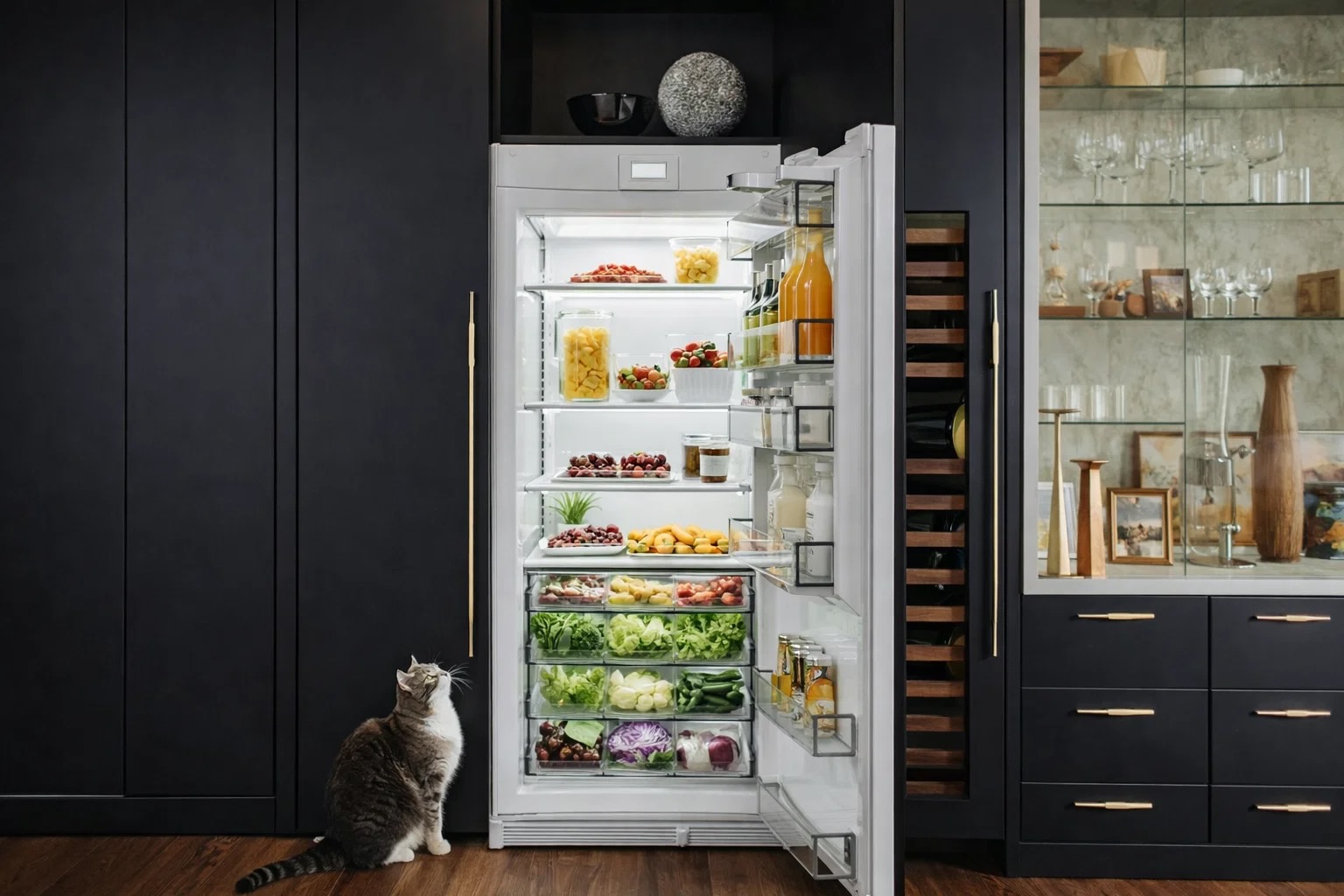
At Sub-Zero Appliance Repair in Atlanta, we see a consistent pattern across Sub-Zero Designer and Integrated Series units: when frost appears anywhere in these systems, it means the balance between airflow, sealing, and defrost control has shifted. These refrigerators and freezers rely on tight installations, precise circulation paths, and accurate sensors. When any of those conditions change: even slightly, you begin to see the classic signs: ice on the rear liner, evaporators packed in frost, drawers freezing along the rails, or a column that cools unevenly.
Because we service DEC, DET, IC, ID, and IT models daily, the frost pattern itself has become one of the most reliable diagnostic tools we use. It shows where the problem starts and how far it has progressed.
In our article, we outline those patterns and provide clear, practical troubleshooting steps and repair guidelines based on real field work with Atlanta homes and installations. The goal is simple: help customers identify the source of frost, understand what it indicates, and know the correct path to resolve it.

Understanding How Frost Acts in Integrated Systems
Sub-Zero’s Designer Series often shows predictable patterns when issues arise. A designer fridge frosting up or an integrated refrigerator frost buildup is usually the first sign that airflow, sealing, or the defrost cycle has shifted out of balance. Rear-wall frost signals circulation loss; a fully iced evaporator suggests incomplete defrosting; ice inside drawers points to infiltration; and frost buildup in a Designer Series column often indicates a sensor or air-return restriction. These patterns form the foundation for troubleshooting integrated frost problems across DEC, DET, IC, ID, and IT models.
Why Frost Appears: The Underlying Mechanical Dynamics

When we examine these systems in the field, four drivers appear again and again.
- Airflow restrictions are a frequent starting point. Designer columns are unforgiving when return vents are blocked or when cabinetry presses against the case. Even a single oversized container against the rear liner can alter circulation paths and create a thin frost sheet that spreads upward over several days.
- Sealing issues tell a different story. A door that appears closed may not actually be sealed, especially if the custom panel has drifted out of alignment or exceeds the allowed weight. Warm, humid kitchen air enters in microbursts, freezes immediately at the leak point, and eventually creeps across drawers and rails.
- Defrost underperformance develops quietly. A heater that weakens with age, a thermostat that doesn’t reset, or a thermistor that no longer reports temperature accurately will allow frost to remain on the evaporator after each cooling cycle. Over time, the evaporator turns into a solid block of ice, airflow collapses, and the compartment warms despite continuous runtime.
- Installation variables round out the group. Integrated appliances are often installed into millimeter-tight cabinetry. When those tolerances shift—after a remodel, hinge adjustment, or panel replacement—the chassis can go slightly out of square. The result is subtle door gaps that produce persistent frosting even though no component has failed.
How We Approach Frost Complaints in the Field
When our technicians arrive on a frost-related service call, we begin with a visual assessment. The frost pattern, the condition of the gaskets, the arrangement of shelves, and the way a door closes tell us more in a minute than any error code. If frost forms on the rear liner while the unit still cools, we suspect airflow imbalance. If drawers are frozen along the rails, we look at panel depth and gasket seating. If the unit is warm and the evaporator is encased in ice, we prepare for a defrost-system evaluation.
Once the visual survey establishes a direction, we perform operational checks. We confirm that evaporator and condenser fans are running, that switches activate properly, and that the compressor cycles as expected. These observations often narrow the cause before the evaporator cover is removed.
When a coil is fully frozen, we conduct a controlled manual defrost—typically 24 to 48 hours. This clears ice so the heater, thermostat, and sensors can be tested accurately. After thawing, we measure the heater’s resistance, verify the thermostat’s continuity, and compare thermistor readings against reference values. We also evaluate defrost timing at the control board. Together, these data points reveal whether the system is failing to defrost, losing airflow, or leaking warm air.
Recognizing Frost Patterns and What They Indicate
Rear-Wall Frost in Refrigerator Columns
A classic IC-24 integrated frost issues pattern, also common in IC-30 and IC-36, begins as a thin sheet of frost. When homeowners search for how to fix frost in Designer Series units, this is often what they are seeing. Circulation loss is the usual driver, though IC-30 poor air circulation can also appear when side channels are blocked. For the DEC line, a DEC2450 frost issue forms under similar conditions, especially when cabinet tolerances are tight.
Evaporator Encased in Ice
A frozen coil behind the panel is the hallmark of incomplete defrosting. Units like DEC1850FI, DEC2450FI, DET3650, and IT-36 often present this pattern. Homeowners describe these symptoms as DEC1850FI not cooling, DEC1850W not cooling, DEC2450R not cooling, DEC2450W not cooling, or DEC2450FI not cooling, depending on the model. In IT-Series units, this same failure appears as IT-30 frost problems or IT-36 frost accumulation. For the IC-36, a heavy ice load on the evaporator often reflects IC-36 defrost heater problems, while a no-clearing defrost cycle across platforms points to integrated defrost heater failure.
Ice Forming in Drawers and Rails
The ID-30CI is well known for ID-30CI ice buildup when the drawer is slightly misaligned or the gasket loses shape. Similarly, freezer columns in the DEC line show integrated freezer frosting when the cabinet or panel alignment allows humidity to enter.
Frost After Cabinet or Panel Work
When frost develops immediately after installation, the cause is almost always mechanical rather than electronic. These are the classic panel ready frost problems found in new kitchens, remodels, or after panel replacement. Any change in cabinet geometry can create leakage points that produce fast-forming frost.
Model Tendencies Seen in the Atlanta Market
DEC units exhibit a range of airflow and defrost behaviors, with DEC2450 frost issue cases among the most common. DET models such as DET3050 and DET3650 regularly show DET3050 frost buildup and DET3650 defrost issues linked to thermistor drift. IC-Series units produce patterns like IC-24 integrated frost issues, IC-30 poor air circulation, and IC-36 defrost heater problems. IT models often surface with IT-30 frost problems or IT-36 frost accumulation due to tight cabinetry or sensor deviations. Homeowners who would rather hand it to a technician can start with Vinings service area.
Restoring Balance: How Frost Problems Are Resolved
To repair Designer Series frost issues, we focus on restoring airflow, sealing, and defrost control.
Airflow Corrections
- Clear blocked vents that trigger integrated refrigerator frost buildup
- Reopen side channels on IC-Series to eliminate IC-30 poor air circulation
- Improve condenser ventilation to reduce designer fridge frosting up
- Relieve tight cabinetry contributing to designer tight installation frost
Sealing and Alignment Corrections
- Correct panel alignment to stop panel ready fridge ice on walls
- Replace or reshape gaskets on DEC, DET, and IT models
- Adjust rails and drawers to resolve ID-30CI ice buildup
- Restore gasket compression to eliminate integrated freezer frosting
Defrost System Repairs
- Replace heaters involved in integrated defrost heater failure
- Install new thermostats and thermistors in columns showing designer series frost buildup
- Verify board timing on units with IC-36 defrost heater problems
- Restore evaporator airflow on DEC and DET columns
Installation Adjustments
- Re-anchor appliances producing panel ready frost problems
- Correct panel depth and hinge geometry
- Restore clearances to stop designer integrated system frost
When Professional Service Is the Right Choice
Homeowners can handle very limited frost-related tasks, but most Designer Series issues call for trained technicians. Here is the practical line between DIY and professional service:
Suitable for Homeowners
- Rearranging shelves to address IC-30 poor air circulation
- Light gasket reshaping when early frost appears
- A single manual defrost when DEC1850FI not cooling or similar symptoms arise
Requires a Professional
- Diagnosing IT-30 frost problems and IT-36 frost accumulation
- Resolving DEC2450R not cooling and heavy evaporator icing
- Repairing DET3050 frost buildup and DET3650 defrost issues
- Correcting sealing failures produced by designer tight installation frost
- Accessing evaporators, sensors, heaters, and control boards
Designer and Integrated models are precise systems; addressing frost correctly means following a structured diagnostic approach rather than simply melting ice.
The Bottom Line
Frost in a Sub-Zero Designer or Integrated system is not random and never cosmetic—it’s the appliance signaling that its balance has shifted. Whether caused by airflow restrictions, warm air infiltration, or incomplete defrost cycles, the frost pattern itself points directly to the root problem. By reading that pattern and following a disciplined diagnostic process, the underlying issue can be corrected without guesswork or unnecessary part replacement.
In the Atlanta market, we see these patterns daily across DEC, DET, IC, ID, and IT models. The solutions vary, but the principle remains the same: restore airflow, sealing, and defrost performance, and the system returns to the stable, efficient operation Sub-Zero engineered. For homeowners, this article offers clarity; for our technicians, it reflects the structured approach that ensures reliable results on every visit. We run this same diagnostic on service calls every week – check service in Decatur, GA for scheduling and what a visit includes.
FAQ
Why does my panel ready fridge have ice on the walls?
This is a common panel ready fridge ice on walls issue caused by sealing loss or cabinet pressure.
How do I fix frost in a Designer Series column?
Begin by identifying whether the pattern comes from airflow loss, infiltration, or defrost timing. These are the fundamentals of how to fix frost in Designer Series units.
My DEC unit is not cooling and covered in frost. Why?
This is typical of DEC1850FI not cooling, DEC1850W not cooling, DEC2450R not cooling, or DEC2450W not cooling conditions caused by incomplete defrosting.
Why does my ID-30CI collect ice in the drawer?
ID-30CI ice buildup is usually due to drawer alignment or gasket deformation.
Why does frost form only at the top of my IC-30 or IC-36?
Side channels may be restricted, leading to IC-30 poor air circulation or IC-36 defrost heater problems.
Can tight cabinetry create frost?
Yes. Designer tight installation frost appears when the appliance is compressed by cabinetry or panels.
