

Designer Series refrigerators tend to signal trouble quietly. A compartment that no longer holds temperature. A touch panel that hesitates. A display that behaves unpredictably. The appliance continues running, yet cooling no longer feels reliable.
In many cases, these changes stem from the electronic control systems that manage temperature, airflow, and communication inside Sub-Zero Designer Series refrigerators. When digital panels, sensors, or WiFi connectivity lose accuracy, cooling performance is often the first thing affected.
Written from the perspective of a Sub-Zero Appliance Repair team that works regularly with Designer Series and integrated column units, this article examines how advanced control issues lead to cooling problems and what those symptoms reveal before more serious failures occur.

When Advanced Controls Begin to Drift
Designer Series refrigerators depend on a tightly coordinated digital system. Touch panels collect user input. Sensors report temperature and humidity. Control boards translate that data into cooling decisions. WiFi adds another layer, handling alerts and system communication.
When this system is stable, performance is precise. When it drifts, the refrigerator does not usually fail outright. Instead, accuracy fades.
This is when homeowners begin to notice that a designer refrigerator is not cooling the way it once did. Settings change, but results do not. Cooling becomes uneven. Certain compartments feel warmer without an obvious reason.
These early signs almost always point toward electronic control instability rather than mechanical breakdown.

Integrated Columns and Hidden Temperature Drift
Integrated and panel-ready refrigerators are designed to disappear into the kitchen. That design choice, however, also hides early symptoms of trouble.
In many homes, complaints about a designer series integrated column not cooling come only after food quality becomes inconsistent. Produce spoils faster. Dairy struggles to stay cold. The refrigerator continues running, but performance never quite stabilizes.
This leads to common questions like why is my integrated fridge warm, even though nothing appears visibly wrong.
In these cases, the issue is rarely cooling capacity. More often, the refrigerator is reacting to inaccurate digital input.
Why “Not Cooling” Rarely Means Mechanical Failure First
When homeowners search for designer refrigerator not cooling, the assumption is often a sealed system issue. In practice, that is rarely the first failure point in Designer Series units.
More commonly, diagnostics show:
- Sensors reporting inconsistent data
- Control boards misinterpreting temperature conditions
- Touch panels accepting input without executing changes
This explains many fixing not cooling issue in designer series service calls where no mechanical component is actually failing. The refrigerator is running. It is simply being guided by flawed instructions.
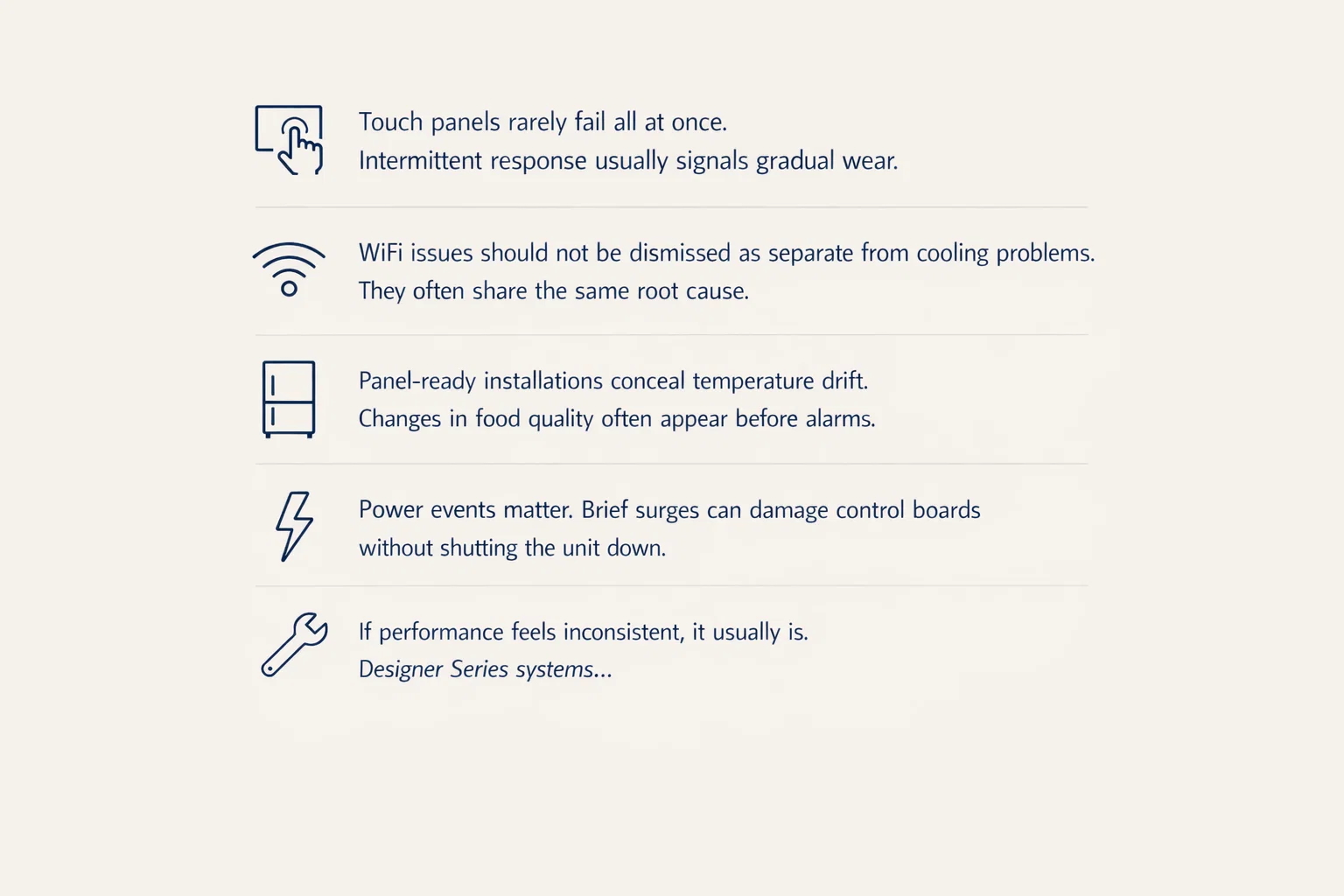
Touch Panels That Stop Responding Reliably
Touch panels are central to Designer Series operation. When they become unreliable, the entire system loses its primary command interface.
We see this most often in cases involving:
- IT-30 touch panel unresponsive
- IC-30 touch control issues
- DET3650 touch panel behavior changes
Symptoms are rarely dramatic. Panels may lag, ignore commands, or revert settings without warning. The display remains lit, giving the impression of normal operation, while input reliability quietly degrades.
Once response becomes inconsistent, cooling accuracy usually follows.
Digital Display Errors and What They Signal
Digital display problems often appear alongside touch panel issues. Numbers flicker. Segments drop out. Temperature readings no longer match internal conditions.
These symptoms are frequently described as:
- IC-24 digital display errors
- DET3050 digital panel problems
While they may look cosmetic at first, display issues usually reflect deeper communication faults between sensors and control boards. When the display loses accuracy, temperature regulation rarely remains intact.
This is a common source of panel ready fridge temperature issues that seem difficult to explain.
WiFi Connectivity Problems Are Often a Warning Sign
WiFi features in Designer Series refrigerators are not just conveniences. They support alerts, diagnostics, and internal communication.
When WiFi becomes unstable, it often coincides with broader electronic strain. Complaints involving designer series WiFi problems, IT-36 WiFi connectivity loss, or IC-36 WiFi not working frequently appear alongside cooling inconsistency or control lag.
In these cases, WiFi failure is not the cause of cooling problems. It is another symptom of control system instability.
When the Refrigerator Runs but Never Gets Cold Enough
One of the most confusing scenarios for homeowners is a refrigerator that runs continuously yet fails to maintain temperature.
Designer Series units rely on constant digital feedback. When sensors misreport conditions or control logic drifts, the system cycles inefficiently. Cooling becomes uneven. Certain zones remain warm even as the compressor continues to run.
This pattern explains many designer series warm fridge fix calls and complaints about an integrated column not getting cold, despite apparent operation.
Common Electronic Causes Behind Not Cooling Complaints
Across Designer Series models, the same electronic issues appear repeatedly during diagnostics:
- Control board degradation
- Touch panel membrane wear
- Display communication faults
- Sensor calibration drift
- Electrical fluctuation damage
These problems sit at the center of most troubleshooting designer not cooling cases, especially in integrated and panel-ready installations where symptoms emerge gradually.
Model Patterns Seen Across the Designer Series
Although each model uses its own hardware configuration, the behavior patterns remain consistent.
Model Family | Common Control Behavior |
DEC1850FI / DEC1850W | Digital control drift affecting cooling stability |
DEC2450FI / DEC2450R / DEC2450W | Integrated column temperature inconsistency |
IC-24 / IC-30 / IC-36 | Display and touch response degradation |
IT-30 / IT-36 | Touch panel and WiFi instability |
DET3050 / DET3650 | Advanced digital panel communication faults |
Different designs, similar outcomes. When electronic accuracy fades, cooling reliability follows.

Practical Signs Pointing to Control Issues
While electronic repair is not a DIY task, certain behaviors consistently indicate control-related problems:
- Temperature changes do not affect cooling
- Touch input responds intermittently
- Digital readings feel unreliable
- Refrigerator warms while freezer performance appears unchanged
When these signs appear together, further adjustment rarely helps.
Why Experience Matters With Designer Series Controls
Designer Series refrigerators are unforgiving of guesswork. Their electronics are model-specific and tightly calibrated.
Effective repair requires digital diagnostics, sensor verification, board-level testing, and system recalibration. Generic approaches often introduce new problems rather than resolving existing ones.
This is why homeowners searching for the best repair for integrated refrigerators typically look for specialists familiar with Designer Series control architecture.
Fixing Not Cooling Issues in the Designer Series
Resolving a fixing not cooling issue in designer series refrigerators rarely starts with replacing major mechanical parts. In many cases, restoring proper communication between the control board, sensors, and user interface corrects cooling behavior.
This is especially true for:
- panel ready fridge temperature issues
- integrated column not getting cold
- cases where the refrigerator runs continuously but never stabilizes
Why Integrated and Panel-Ready Units Require Specialized Diagnosis
Integrated refrigerators are designed to disappear visually. That same design can delay problem recognition.
Temperature drift may not trigger alarms immediately. External surfaces remain unchanged. Noise levels stay normal. Meanwhile, internal conditions move further out of range.
For homeowners searching for the best repair for integrated Sub-Zero refrigerators, experience with Designer Series electronics matters. These systems require model-specific testing, calibration, and verification to restore proper function.
Final Thoughts
Sub-Zero Designer Series refrigerators rely on advanced digital systems to deliver consistent cooling. Touch panels, digital displays, sensors, and WiFi connectivity all play a role in maintaining performance.
When cooling problems appear, the cause is often electronic rather than mechanical. Touch panel failures, display errors, and connectivity issues quietly undermine accuracy before a complete failure ever occurs. Not sure whether it is worth a service call? Check Sub-Zero repair in Dunwoody for what we look at on arrival.
Understanding how these systems behave makes it easier to recognize problems early and act before performance declines further.
Precision appliances perform best when precision is restored at the first sign of drift.
FAQ
Why is my integrated fridge warm even though it is running
In most cases, this points to a control or sensor issue. The refrigerator continues operating, but digital feedback is no longer accurate, causing uneven cooling.
Can WiFi problems affect cooling in Designer Series refrigerators
Yes. Designer series WiFi problems often appear alongside broader electronic instability. While WiFi itself does not cool the unit, connectivity loss can signal deeper control issues.
What causes touch panels to stop responding
Wear over time is the most common cause. Moisture, heat, and normal use can degrade touch membranes and internal connections, leading to touch panel unresponsive behavior.
Are digital display errors a serious concern
They can be. Digital display errors often reflect communication problems between sensors and control boards. When the display loses accuracy, temperature regulation usually follows.
Should the control panel or control board be replaced
That depends on diagnostics. Some failures involve the interface, others the main board. Accurate testing determines the correct repair path.
