

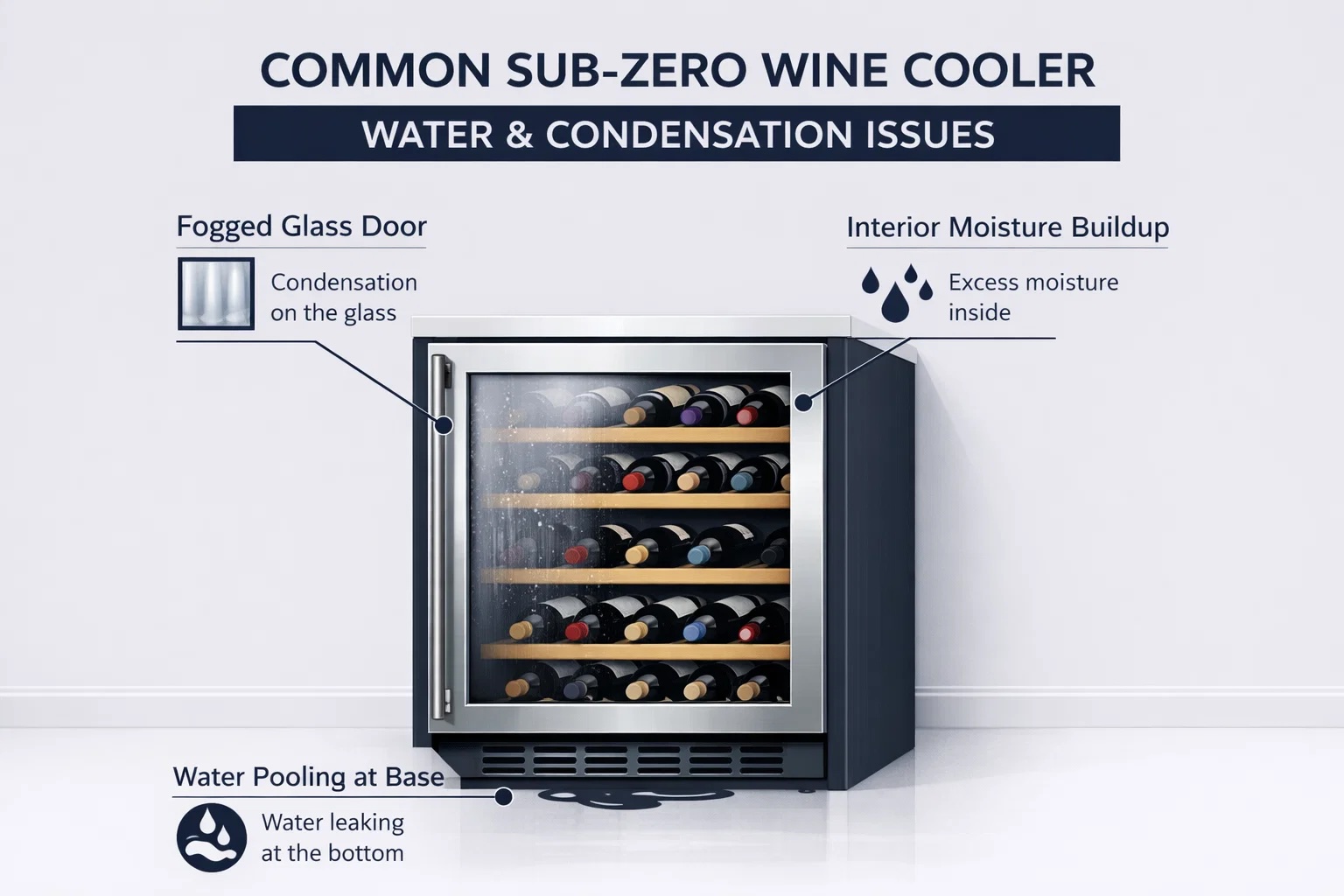
Water in your Sub-Zero wine cooler signals one of three failures: condensation control breakdown, humidity sensor malfunction, or door seal compromise. Wine storage units operate differently than standard refrigerators—they maintain 55-65°F with 50-70% humidity, creating conditions where moisture problems develop quickly.
The 427, 427R, 427G, 427RG, 424, UW-24, DEC2450W, and DEC3050W models all face similar moisture challenges. Glass door fogging, water pooling on shelves, and label damage indicate the system cannot manage humidity properly.
In this guide we explain wine cooler water problems, identify causes of wine storage condensation issues, and provide solutions for both single and dual zone wine cooler moisture problem scenarios. Most issues trace to environmental factors or minor component failures rather than sealed system damage. If you are outside DIY territory on this one, reach a technician through Druid Hills repair service.
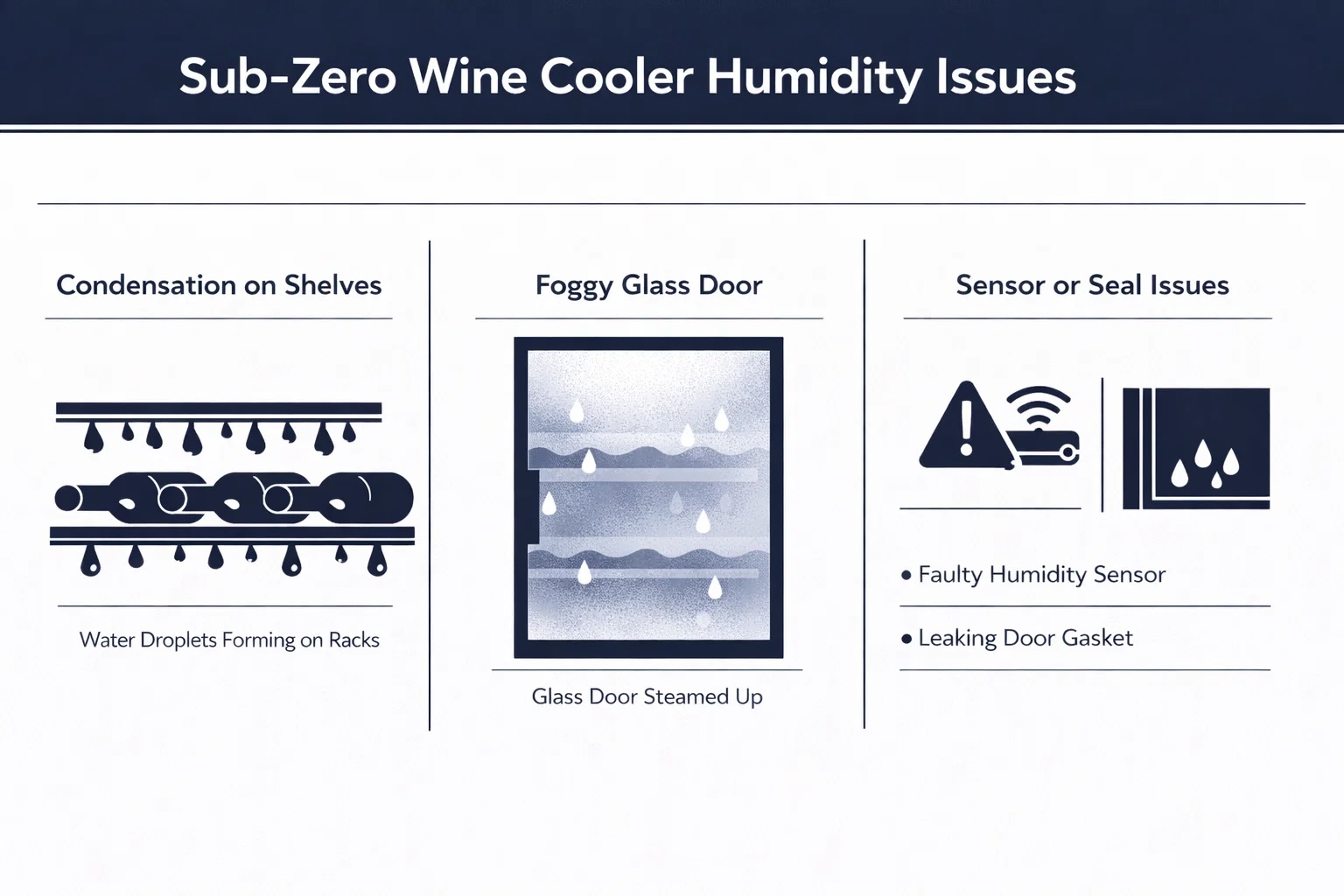
Why Wine Coolers Develop Water Issues
Wine preservation requires higher humidity than food storage—50-70% versus 30-40% in refrigerators. This moisture prevents corks from drying but creates condensation when conditions shift.
How Wine Storage Humidity Works
Design parameters:
- Temperature: 55-65°F (optimal wine aging)
- Humidity: 50-70% (prevents cork desiccation)
- Minimal temperature fluctuation (±2°F maximum)
Where moisture originates:
- Air infiltration: Opening the door introduces warm, humid Atlanta air (70-85% summer humidity)
- Thermal cycling: Temperature changes cause water vapor to condense on cold surfaces
- Evaporation: Wine bottles themselves release minimal moisture through corks over time
- Defrost cycles: Some models use active cooling that creates frost requiring periodic defrost

Common Moisture Presentations
Issue | Location | Typical Cause | Urgency |
Glass door fogging | Exterior glass surface | Temperature differential, ambient humidity | Low |
Interior condensation | Walls, ceiling | Excessive air infiltration, seal failure | Medium |
Water pooling | Shelves, floor | Drain blockage, humidity sensor failure | High |
Bottle label damage | Throughout unit | Sustained high humidity above 75% | Medium |
Wine cooler glass fogging on the exterior is often environmental and cosmetic. Wine refrigerator interior moisture pooling indicates system malfunction requiring attention.
Glass Door Condensation
External fogging—moisture forming on the outside glass surface—is the most common wine storage condensation issues complaint but least indicative of actual malfunction.
Exterior vs. Interior Condensation
Exterior fogging (outside glass):
- Occurs when ambient air humidity exceeds 60% and the room is warmer than the unit
- Atlanta summers (75-85% humidity) create this regularly
- Cosmetic issue that does not affect wine
- Normal operation, not a defect
Interior condensation (inside glass or on bottles):
- Water droplets inside the cabinet on glass, walls, or bottles
- Indicates door seal failure, drainage problem, or humidity control malfunction
- Can damage labels and compromise wine quality
- Requires correction
Quick Test for Glass Door Issues
Exterior condensation test:
- Wipe the glass completely dry
- Wait 15 minutes without opening the door
- Check which side has moisture
Results:
- Moisture on the outside only = environmental, normal in humid conditions
- Moisture on the inside = door seal or humidity control failure
- Moisture on both sides = multiple issues present
DEC3050W glass door condensation and similar complaints in Atlanta homes are typically exterior environmental moisture, not unit malfunction. However, persistent wine cooler condensation inside the cabinet requires investigation.
Environmental Solutions for Exterior Fogging
Reduce ambient humidity:
- Run a dehumidifier in the wine storage room (target 50-55% RH)
- Improve room ventilation
- Keep the kitchen or storage area air-conditioned
Modify door opening patterns:
- Minimize opening frequency
- Retrieve bottles quickly (under 30 seconds)
- Allow the unit to stabilize 10+ minutes between openings
Installation considerations:
- Avoid locations near dishwashers or cooking areas
- Ensure adequate room air circulation
- Consider built-in versus freestanding placement effects
TECHNICAL NOTE: The UW-24 and other undercounter wine units experience more exterior fogging than built-in models due to exposed glass surfaces and floor-level ambient humidity concentrations.
Interior Moisture and Water Pooling
Water pooling in wine storage units indicates drainage failure, excessive humidity generation, or compromised door seals. This is not normal operation.
Drainage System Failures
Wine coolers with active cooling cycles (compressor-based) generate frost on evaporator coils. Periodic defrost melts this frost. Water must drain properly.
Drain blockage symptoms:
- Water pooling on the bottom shelf or floor
- Ice buildup on the rear interior wall
- Labels peeling from lower bottles
- Musty odor developing
Common blockage causes:
Blockage Type | Development Time | Solution | Prevention |
Cork debris | 6-12 months | Flush drain with warm water | Regular inspection |
Mineral deposits | 2-4 years | Bleach solution flush | Annual maintenance |
Mold/biofilm | 12-18 months | Clean with antimicrobial | Quarterly cleaning |
Clearing wine cooler drain (accessible models):
- Power off the unit
- Remove all bottles and shelving
- Locate the drain opening (typically rear lower section)
- Use a turkey baster to remove standing water
- Flush with warm water mixed with 2 tablespoons white vinegar
- Verify water drains to the pan beneath the unit
- Clean the drain pan if accessible
Models requiring professional service:
- Built-in wine columns (sealed construction)
- DEC2450W and DEC3050W (integrated construction)
- Units under warranty (maintain coverage)
Professional service is essential for these models because drain access requires removing internal components without damaging cabinetry integration. Our technicians have specialized tools and training for safe, efficient service on all integrated models.
Professional drain service: $120-$200 including inspection and cleaning.
Humidity Sensor Failures
Wine cooler humidity sensor failure prevents proper moisture regulation. The system cannot detect actual cabinet humidity, leading to either excessive dryness (corks shrink) or oversaturation (labels peel).
Failure indicators:
- Humidity reading stuck at one value (if display equipped)
- Excessive condensation despite proper door sealing
- Bottles developing mold on labels
- Cork ends showing mold growth
- Wine fridge humidity problem persisting after drain cleaning
How humidity sensors fail:
- Corrosion from prolonged moisture exposure (5-8 years typical life)
- Calibration drift (reads 50% when actual is 75%)
- Complete electrical failure (no signal to control board)
- Physical damage from bottle contact
Testing humidity levels:
- Place a separate hygrometer inside the unit (calibrated instrument, not cheap models)
- Monitor for 24 hours
- Compare to the unit’s display (if equipped)
- Difference of 10%+ indicates sensor failure
Sensor replacement:
- Part cost: $80-$150
- Professional installation: $150-$250 total
- Requires calibration after installation
- Some models need control board reprogramming
Models 424 and 427 series use similar sensors. When you see 424 not cooling or 427 not cooling combined with moisture issues, sensor failure often affects both temperature and humidity control systems.
Door Seal Compromise
Wine Cooler Seal Testing
Visual inspection specific to wine units:
- Check the seal around the entire glass door perimeter
- Look for gaps at bottom corners (most common failure point)
- Inspect for wine staining (indicates moisture escaping)
- Check for cork dust accumulation in the seal channel
Paper test adapted for wine coolers:
- Use thin paper (standard printer paper)
- Should have moderate resistance, not extreme
- Wine cooler seals operate with less compression than refrigerator gaskets
- A slightly easier pull is acceptable if consistent around the perimeter
Humidity test:
- Close the door on a piece of paper
- Open after 2 hours
- Paper should be dry (not damp from interior humidity)
- Damp paper indicates the seal is allowing moisture exchange
Common Seal Failure Patterns
24 inch wine cooler water problems often stem from bottom seal failure where cold air sinks and seal compression is weakest.
30 inch wine storage condensation in dual-zone models shows different patterns in each zone—the upper zone typically has more door stress from handle location.
Glass door-specific issues:
- Glass expansion and contraction stress seal mounting
- Visual seal condition does not always correlate with performance
- Dual-pane glass units have additional sealing challenges
Replacement Considerations
DIY seal replacement challenges:
- Wine cooler seals are model-specific (not universal)
- Glass door alignment is critical (affects seal contact)
- Some models have two-part seals (inner and outer)
- Adhesive-backed seals require careful installation
Professional installation benefits:
- Correct seal for the exact model
- Glass door realignment if needed
- Hinge adjustment to ensure proper closure
- Warranty on installation work
Costs:
- Seal part: $120-$200
- Professional installation: $250-$400 total
- Dual-zone models may need two seals
When addressing why is my wine fridge wet, seal failure combined with humidity sensor issues creates compounding moisture problems requiring both repairs.
Model-Specific Issues
427 Series Problems
The 427, 427R, 427G, and 427RG models share common architecture with some variations.
Common issues:
- 427 water leak fix typically involves the drain system and lower door seal
- Single versus dual refrigerant systems affect cooling patterns
- Glass door seal at the hinge side fails more frequently
- Humidity sensors are located near the evaporator coil (prone to corrosion)
427 not cooling scenarios often include moisture problems because the evaporator runs continuously trying to reach temperature, creating excessive frost and defrost water.
Specific failure patterns:
- 427R not cooling (right-hand hinge): seal failure at the hinge side
- 427G not cooling (glass door variant): dual-pane seal compromise
- 427RG not cooling: combination issues requiring systematic diagnosis
424 Series
The 424 is a smaller capacity unit with a proportionally higher surface-area-to-volume ratio, making it more sensitive to door seal and humidity control issues.
424 not cooling combined with moisture indicates the smaller compressor system is overwhelmed. These units need more frequent maintenance than larger models.
424 condensation fix procedures:
- Verify the door seal is completely intact (even minor gaps are problematic in small units)
- Check ambient room temperature (should be 65-75°F maximum)
- Reduce door opening frequency (60-second recovery time needed)
- Consider a room dehumidifier if ambient exceeds 60% RH
UW-24 Undercounter Wine Storage
Undercounter-specific challenges:
- Limited ventilation compared to freestanding units
- Floor-level installation in the highest humidity zone of the kitchen
- Drain pan access is more difficult
- Toe-kick grille restricts airflow
UW-24 maintenance requires quarterly drain inspection rather than annual due to higher debris accumulation from floor-level operation.
Integrated Wine Columns
DEC2450W humidity issues and DEC3050W glass door condensation stem from sealed built-in construction.
Integrated model challenges:
- Sealed construction requires specialized service approach
- Humidity sensors are not user-replaceable
- Door seal replacement requires careful cabinetry consideration
- Dual-zone models have two independent systems
Our technicians are trained specifically on DEC2450W and DEC3050W moisture problems, with the tools and expertise for integrated wine column service.
Dual Zone Complications
Dual zone wine cooler moisture problem scenarios involve two independent cooling zones with separate humidity management.
How Dual Zones Create Moisture Issues
Design complexity:
- Two temperature zones (typically 45-55°F and 55-65°F)
- Shared air space with a divider
- One door seal serving both zones
- Two humidity sensors (or one averaged sensor)
Moisture migration:
- The warmer zone (upper) has a higher saturation point
- The cooler zone (lower) condenses moisture from the upper zone
- Poor divider seal allows air exchange
- The lower zone accumulates excess water
Diagnostic Approach for Dual Zones
Zone-specific testing:
- Upper zone assessment:
- Check the seal along the top of the door
- Verify the temperature reading is accurate (use a separate thermometer)
- Look for condensation on the divider
- Lower zone assessment:
- Check for water pooling (receives drainage from the upper zone)
- Verify the drain operates properly
- Test the seal along the bottom of the door
- Cross-zone issues:
- Temperature differential between zones should be stable
- Excessive differential (15°F+) indicates divider seal failure
- Moisture in the lower zone while the upper stays dry suggests a drainage path problem
Repair Priority for Dual Zones
Address in this order:
- Door seal (affects both zones)
- Drain system in the lower zone (collects water from both)
- Zone divider seal (prevents moisture migration)
- Individual humidity sensors (if equipped)
- Temperature control calibration (affects humidity capacity)
Cost for dual-zone repairs:
- Single seal serving both zones: $250-$400
- Dual drain service: $180-$280
- Divider seal replacement: $150-$250
- Multiple issues: $400-$700 comprehensive service
Environmental Factors
Atlanta Climate Impact
Wine storage moisture problems intensify in southeastern humidity.
Summer challenges (May-September):
- Ambient humidity 70-85% is typical
- Room temperature fluctuations occur
- Air conditioning cycling creates humidity swings
- More frequent door openings (entertaining season)
Solutions for Atlanta installations:
- Dedicated room dehumidifier (maintain 50-55% RH)
- Avoid locations near exterior doors
- Ensure adequate AC in the wine storage room
- Consider wine cellar conversion for serious collectors
Installation Location Effects
Location | Moisture Risk | Mitigation |
Kitchen (near sink/dishwasher) | Very High | Relocate or install room dehumidifier |
Basement | Moderate-High | Address basement humidity first |
Interior closet with AC | Low-Moderate | Ensure adequate ventilation |
Dedicated wine room | Low | Maintain room conditions optimally |
Wine unit humidity control is easier in dedicated climate-controlled spaces than in multi-purpose rooms.
Troubleshooting Guide
Systematic Diagnosis
Step 1: Identify moisture location (5 minutes)
- Exterior glass fogging only = environmental
- Interior walls/ceiling = seal or humidity sensor
- Water pooling on shelves = drain blockage
- Bottle labels peeling = excessive sustained humidity
Step 2: Door seal assessment (10 minutes)
- Visual inspection for gaps or damage
- Paper test around the entire perimeter
- Check for wine stains indicating moisture escape
- Verify the door closes completely without force
Step 3: Drainage verification (15 minutes)
- Remove bottles and check for standing water
- Look for ice buildup on the rear wall
- Access the drain pan if possible
- Pour a small amount of water in the drain to test flow
Step 4: Humidity measurement (24-hour period)
- Place a calibrated hygrometer inside the unit
- Monitor the reading for a full day
- Compare to the unit’s display (if equipped)
- Note any dramatic fluctuations
Step 5: Environmental assessment
- Measure room temperature and humidity
- Count door openings over a typical day
- Check room ventilation adequacy
- Consider seasonal patterns
When to Call Professionals
Immediate service needed:
- Water pooling is damaging bottles
- Multiple bottles are showing mold
- Unit is not maintaining temperature at all (427 not cooling, 424, etc.)
- Visible water is leaking onto the floor
Schedule within a week:
- Persistent interior condensation after seal cleaning
- Suspected humidity sensor failure
- Drain blockage in integrated models
- Wine cooler leaking water at a slow rate
DIY appropriate:
- Exterior glass fogging (environmental control)
- Accessible drain cleaning on freestanding models
- Door seal inspection and cleaning
- Room dehumidifier installation
Maintenance Protocol
Monthly Tasks (10 minutes)
- Wipe the door seal with a damp cloth
- Check for water pooling on the bottom shelf
- Clean the glass door interior and exterior
- Verify the unit is maintaining the correct temperature
Quarterly Tasks (30 minutes)
- Clean the accessible drain opening
- Place a fresh hygrometer inside for a 24-hour test
- Inspect bottle labels for moisture damage
- Check the drain pan if accessible
Annual Professional Service ($150-$200)
- Complete drain system cleaning
- Door seal integrity testing and adjustment
- Humidity sensor calibration verification
- Temperature accuracy testing
- Compressor operation assessment
- Comprehensive system health check
Prevention value: Annual service prevents 60-70% of wine cooler water problems and repair wine cooler water issue emergencies.
Cost Summary
Issue | DIY Cost | Professional Cost | Service Notes |
Drain cleaning (accessible) | $5-$10 | $120-$200 | We include drain pan inspection and antimicrobial treatment. Freestanding models accessible to owners; integrated units have sealed construction requiring our professional service. |
Door seal replacement | $120-$200 | $250-$400 | Our installation includes glass door realignment, hinge adjustment, and seal warranty. Critical for maintaining proper humidity levels. |
Humidity sensor | $80-$150 (parts only) | $150-$250 | Requires multimeter testing, wiring expertise, and control board calibration. We use sensors and verify accuracy post-installation. |
Dual-zone comprehensive | $300-$450 (parts only, advanced DIY) | $400-$700 | Addresses seals, sensors, divider, and drainage in both zones. We diagnose zone interaction issues that DIY approaches miss. Professional service recommended. |
Room dehumidifier | $200-$350 | $80-$120 (installation only) | We assess optimal placement for wine storage humidity control and can recommend commercial-grade units for serious collections. |
Annual maintenance | Not recommended without experience | $150-$200 | Comprehensive service includes humidity calibration, drain system cleaning, seal testing, and temperature accuracy verification. Prevents 60-70% of moisture emergencies. |
Why choose Subzero Repair Techs for wine cooler service:
- Experienced technicians with 15+ years of hands-on work on Sub-Zero wine storage models
- We carry humidity sensors and seals in our service vehicles for same-day repairs
- Specialized equipment for dual-zone diagnostics and calibration
- Understanding of how Atlanta’s climate affects wine storage systems
- 90-day parts and labor warranty on all humidity and condensation repairs
- Wine collection protection is our priority—we work quickly to minimize storage disruption
The Bottom Line
Wine cooler condensation and moisture issues stem from the delicate balance wine storage requires—higher humidity than refrigerators but precise control to prevent water problems. Most troubleshooting water in wine cooler scenarios involve environmental factors, door seals, or drainage rather than refrigeration system failures.
Address exterior glass fogging through humidity control in the room, not unit repair. Address interior moisture through seal inspection, drain maintenance, and humidity sensor verification. The 427 water leak fix or 424 condensation fix often requires multiple interventions—seal, drain, and environmental adjustments together.
Regular maintenance prevents most issues. Annual professional service costs $150-$200 but protects wine collections worth thousands. Wine refrigerator interior moisture damages labels, promotes mold, and compromises wine quality—prevention is substantially cheaper than collection replacement.
FAQ
Why is my wine fridge wet inside but the temperature seems correct?
The humidity sensor likely failed but the temperature sensor still works. Wine coolers have separate sensors for temperature and humidity. A failed humidity sensor cannot regulate moisture even when cooling functions properly. Place a hygrometer inside for 24 hours—if it reads 75%+ while the unit displays normal or no humidity data, the sensor needs replacement ($150-$250 professionally installed).
Can I fix the wine cooler leaking water from the door myself?
Check the door seal first. Wipe it clean, inspect for cracks or gaps, then do the paper test around the entire perimeter. If the seal looks good but moisture persists, the drain is likely clogged. Freestanding models allow drain cleaning (follow our guide above). Integrated models like the DEC2450W or DEC3050W require professional service due to sealed construction.
How often should I service my wine cooler to prevent water pooling in wine storage?
Quarterly inspection for undercounter models like the UW-24 (floor-level units accumulate debris faster). Annual professional service for all other models. Between services, wipe door seals monthly and check for standing water. Atlanta’s humidity makes wine coolers work harder than in dry climates—preventive maintenance costs $150-$200 annually but prevents $400-$700 emergency repairs.
