
Outdoor Sub-Zero units work in conditions that indoor refrigerators never face. Heat, rain, humidity, and wind affect drainage, seals, and metal surfaces every single day. When an outdoor refrigerator begins leaking water or when rust appears around the lower frame, the appliance is reacting to moisture that is not draining or sealing the way it should. We see these issues often in outdoor models such as the UC-24RO, ID-24RO outdoor drawer, DEU2450RO, and the UC-15IO outdoor ice maker.
Leaks often show up together with cooling complaints. Many homeowners call us because there is water on the patio and the refrigerator is no longer keeping temperature. This is a common pattern in older outdoor systems such as the 511 not cooling, 550 not cooling, 590 not cooling, 661 not cooling, and 700BR not cooling. Once moisture enters the cabinet, the evaporator slows down and the refrigerator warms.
Below is a clear, structured explanation of why outdoor Sub-Zero units leak and rust, how these problems affect cooling, and how we diagnose and repair them. Not sure whether it is worth a service call? Check Suwanee Sub-Zero service for what we look at on arrival.
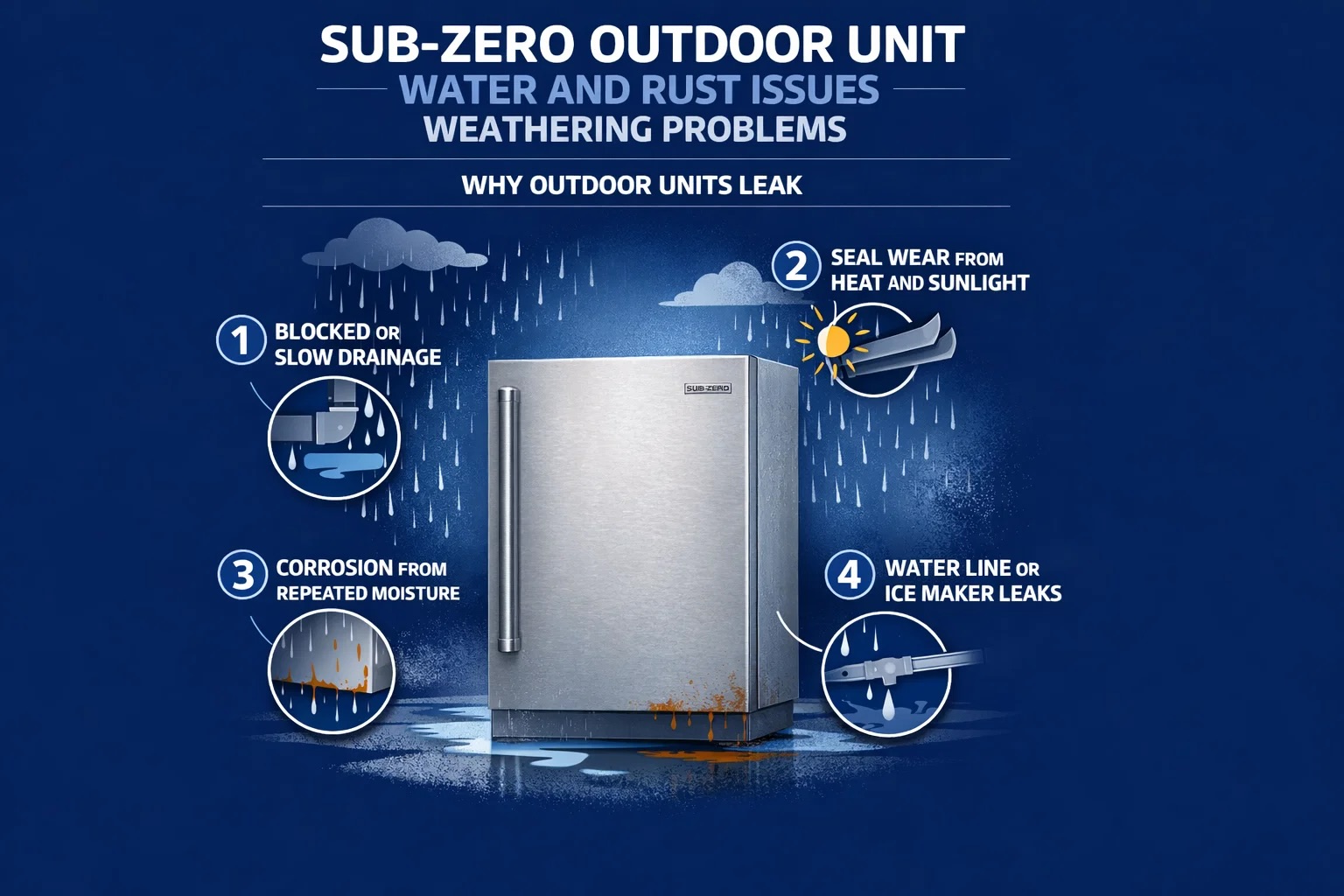
Why Outdoor Sub-Zero Units Leak
Outdoor units rely on a gravity drain system, a tight seal, and clean metal surfaces. Weather affects all three.
1. Blocked or slow drainage
Outdoor refrigerators collect dust, pollen, insects, and debris around the drain area. When the drain slows, water rises inside the liner or escapes at the front. This is one of the most common causes of an outdoor refrigerator water leak and appears often in UC-24RO water leak service visits.
2. Seal wear from heat and sunlight
Outdoor gaskets dry out faster and lose compression. Once the seal relaxes, warm outside air enters the refrigerator and condenses on cold surfaces. This often results in a 24 inch outdoor refrigerator leak or an ID-24RO outdoor drawer leak.
3. Corrosion from repeated moisture
Moisture that collects under the trim or near the hinges leads to outdoor refrigerator corrosion. Rust also affects alignment, which can make leaks worse.
4. Water line or ice maker leaks
Units with water lines, including the UC-15IO ice maker, can develop leaks when tubing hardens or fittings loosen from outdoor temperature changes.
Rust & Corrosion forming on a Sub-Zero outdoor unit due to standing moisture and weather exposure
How Moisture and Rust Affect Cooling
Moisture interferes with airflow and evaporator performance. When water reaches the evaporator, cooling slows down.
Common signs that water is affecting cooling:
- The refrigerator runs longer than normal
- Temperature rises after a leak appears
- Frost develops faster than usual
- Airflow feels weak inside the cabinet
This is why we often see UC-24RO not draining properly or 700BR not cooling at the same time as a visible leak.
Problem, Cause, and Solution
This is the diagnostic pattern we follow during service calls.
A simple table helps present it clearly.
Problem | Likely Cause | What We Do |
Water on the ground or patio | Drain blocked or drain tray out of level | Clear the drain, flush the line, level the tray |
Water pooling inside the drawer | Seal not holding contact, warm air entering | Test and replace seal, adjust drawer alignment, dry liner |
Rust on lower frame or hinge | Moisture sitting in one place | Treat metal, remove rust, correct drainage path |
Cooling issues appear with a leak | Moisture reached evaporator | Dry evaporator, remove frost, test fan and thermistor |
Outdoor ice maker leak (UC-15IO) | Tubing hardened or fittings loosened | Replace tubing, secure fittings, adjust routing |
Homeowner Checks Before Calling Us
These steps help confirm the direction of the problem and are safe to do.
Check 1: Look at the seal
If you see gaps or stiff sections, the seal is likely allowing humid air inside.
Check 2: Look for water under the bins
Water here often means the drain is slow or the seal is letting in moisture.
Check 3: Inspect lower trim and hinges
Rust indicates long-term moisture exposure.
Check 4: Verify temperature stability
Any temperature rise after a leak means the evaporator is affected.
Check 5: Listen for longer run cycles
A refrigerator that runs longer is trying to overcome moisture issues.
If water returns within one or two days, professional service is required because the drainage system, seal, or evaporator needs attention.
How We Repair Outdoor Sub-Zero Units
Our team has extensive hands-on experience with all outdoor Sub-Zero systems.
Our repair steps typically include:
- Clearing and flushing drainage pathways
- Testing and replacing worn seals
- Treating corrosion and protecting metal surfaces
- Correcting water line routing on UC-15IO and similar units
- Resetting the evaporator by removing moisture and frost
- Verifying stable temperature and airflow after the repair
Outdoor refrigerators need periodic maintenance because of their constant exposure to weather conditions. Repairs help protect both the appliance and the outdoor kitchen around it.
Schedule Outdoor Sub-Zero Repair
If your outdoor Sub-Zero unit is leaking, rusting, or warming up, we can help. Our technicians service UC-24RO, ID-24RO, DEU2450RO, UC-15IO, and all outdoor Sub-Zero configurations. We restore drainage, correct water leaks, repair corrosion, and return the refrigerator to reliable performance.
FAQ
Why is my outdoor refrigerator leaking water
Drainage may be blocked, the seal may be worn, or water may be collecting under the cabinet from weather exposure.
Can rust affect cooling
Yes. Rust can shift drawer or door alignment, which allows warm air inside.
How can I fix water leak in fridge units outdoors
Check the drain and inspect the seal. If moisture continues, the unit requires a professional drainage and airflow inspection.
Why does my UC-15IO ice maker leak
Tubing and fittings may have hardened or shifted due to outdoor heat.
Do outdoor units fail sooner than indoor ones
Outdoor heat, humidity, and debris accelerate seal wear, corrosion, and drainage problems.
