

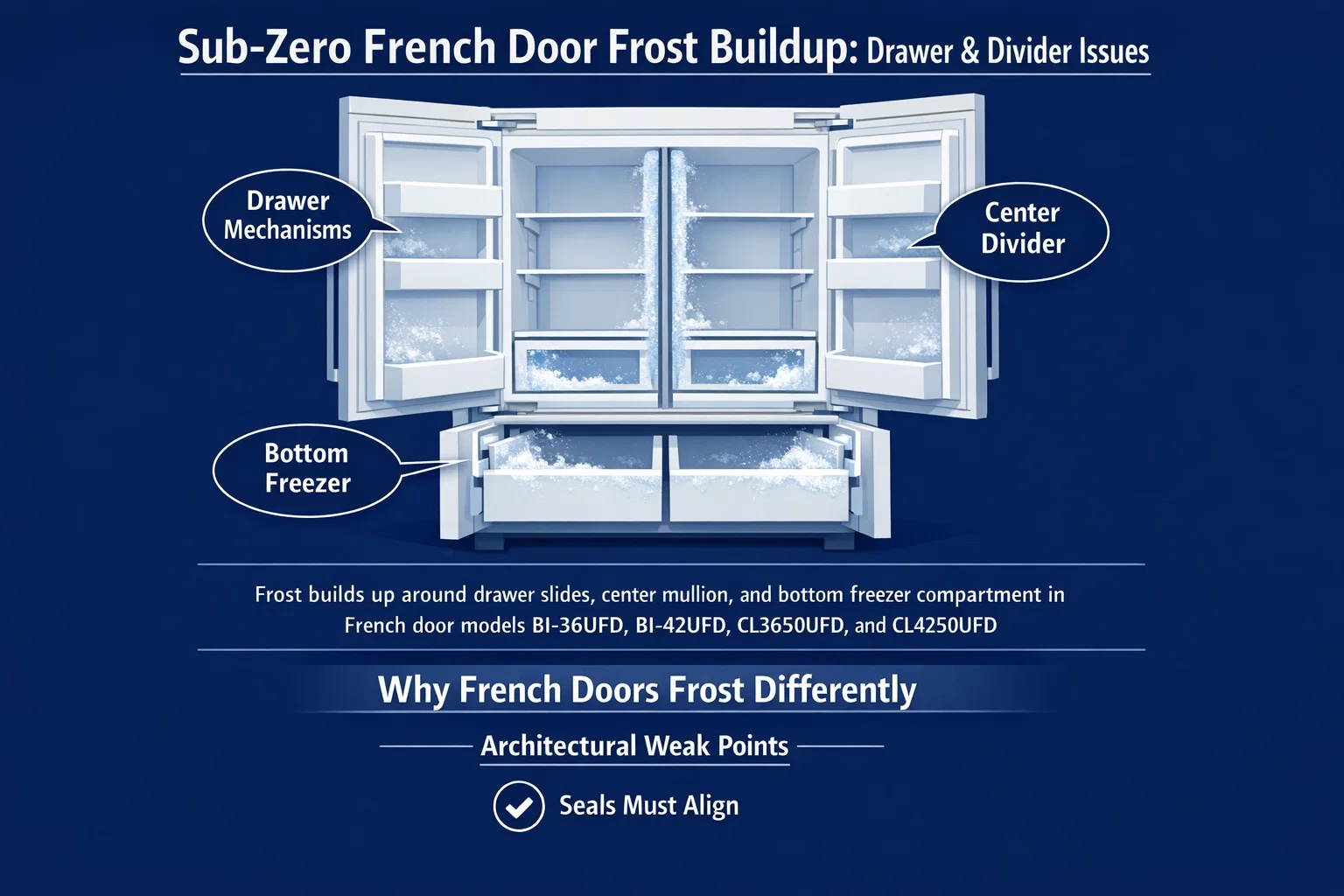
Frost in Sub-Zero French door refrigerators concentrates in three locations: drawer mechanisms, center dividers, and bottom freezer compartments. The BI-36UFD, BI-42UFD, BI-36UFDID, BI-42UFDID, CL3650UFD, and CL4250UFD models share this pattern because their architecture creates specific thermal vulnerabilities.

Ice forms where cold air escapes or warm air infiltrates—drawer slides, center mullion seals, and the refrigerator-freezer junction.
Our guide explains french door refrigerator frost buildup, answers why is my french door fridge icing up, and shows how to fix frost in french door units. This is a routine visit for our team – you can book it through same-day service in Suwanee.
Why French Doors Frost Differently
French door refrigerators have unique construction creating frost vulnerabilities absent in other configurations.
Architectural Weak Points
Design elements:
- Two independent refrigerator doors meeting at center
- Center mullion with dedicated seal and heating element
- Pull-out freezer drawer at bottom
- Three separate door systems requiring perfect seal alignment
Where frost develops:
Location | Why It Happens | Models Affected |
Center divider | Two-door junction creates seal gap vulnerability | All French door models |
Drawer mechanism | Freezer drawer slides allow air path when misaligned | BI-36UFD, BI-42UFD, CL models |
Door hinge side | Hinges flex more than handle side | All models |
Bottom door edges | Cold air sinks, concentrates at lowest seal point | All models |
A single-door refrigerator has one continuous seal. French doors have three separate sealing systems that must all work perfectly. When one fails, french door frost buildup accelerates rapidly.
Temperature Gradient Impact
French doors create a horizontal temperature difference: 38°F refrigerator sits directly above 0°F freezer. Cold air naturally rises into warmer space above when drawer seals fail. This differs from side-by-side models where cold and warm compartments sit beside each other.
Drawer frost in french door units accumulates faster than door frost because the horizontal seal faces upward. Any gap immediately allows cold air to escape into the refrigerator compartment above.
Center Divider Problems
The center mullion—where refrigerator doors meet—causes the most french door freezer frosting complaints. This vertical divider contains a heating element preventing frost, but several factors create failure.
How Mullions Work and Fail

Function:
- Heated strip runs the divider’s length
- Maintains temperature slightly above freezing
- Prevents frost when doors close against it
- Creates magnetic seal surface
What causes failure:
- Heating element burnout (8-12 year lifespan)
- Loose electrical connection
- Control board stops sending power
- Door misalignment creates gaps despite heating
Diagnosing Center Issues
CL3650UFD center divider frost follows this pattern:
- Open both doors fully
- Examine center divider for frost or ice
- Feel the divider—should be slightly warm
- Check both sides (frost sometimes appears on one side only)
Frost patterns and what they mean:
Pattern | What Went Wrong | Fix |
Even frost, entire divider | Mullion heater failed | Replace element |
Top only | Top door misaligned | Adjust door |
Bottom only | Bottom seal failed | Replace gasket |
One side frosted | Single door misalignment | Adjust affected door |
Chunky ice buildup | Water freezing on divider | Check for leaks above |
CL4250UFD icing problem scenarios often combine mullion heater failure with door misalignment—the heater failed first, doors shifted trying to close against ice. The CL3650UFD ice buildup follows an identical pattern in the 36-inch configuration.
Replacement costs: $250-$400 including parts and labor, with door realignment and seal inspection.
Drawer Mechanism Frost
Bottom freezer drawer frost stems from the sliding mechanism and horizontal seal configuration.
Why Drawers Frost
Mechanical factors:
- Drawer slides on tracks with clearance gaps
- Loaded drawer weight (60-80 lbs) stresses front seal
- Horizontal seal faces upward (cold air rises through gaps)
- Drawer face must seal while supporting weight
Common failures:
- Front drawer seal degrades from constant motion
- Slide tracks shift, drawer doesn’t seat properly
- Drawer face warps from temperature cycling
- Food items prevent complete closure
Diagnosing Drawer Issues
BI-36UFD frost in drawer diagnostic process:
Seal inspection (5 minutes):
- Open drawer fully
- Check gasket around opening for cracks, tears, compression
- Examine corners (highest stress points)
Alignment check (5 minutes):
- Close drawer, observe gaps
- Should close evenly with no visible light
- Check left-right alignment
- Verify level positioning
Frost location analysis:
Location | What It Indicates | Solution |
Front edge | Gasket failed | Replace seal |
One side | Misaligned on tracks | Adjust slides |
Top | Tilted forward | Level drawer |
Ice on drawer face | Water dripping from above | Check refrigerator drain |
BI-42UFD frost problems often involve multiple issues—failed gasket plus misaligned slides. Fixing only one doesn’t stop the frost. The BI-42UFD frost issues we service require addressing both seal and alignment together.
Drawer seal replacement: $220-$350 including alignment and testing.
Door Seal Failures
French door defrost issues misdiagnosed as defrost system problems often stem from door seal failures allowing humid air infiltration.
Testing Seals
Paper test for French doors:
- Test each door individually with paper inserted around entire perimeter
- Check resistance at hinge side (most stress)
- Test center where doors meet (firm resistance required top to bottom)
- Check bottom edges (this area fails first)
Visual inspection priorities:
- Hinge side: Cracks, tears, permanent compression from door weight
- Bottom corners: Seal separation, food debris accumulation
- Center meeting point: Both doors’ seals must be intact
- Top center: Often overlooked but allows warm air entry
When Doors Need Adjustment
BI-36UFD not cooling and BI-42UFD not cooling sometimes trace to door misalignment creating seal gaps rather than cooling system failure. Frost accumulates, then blocks airflow, then the refrigerator warms.
Adjustment indicators:
- One door sits higher when closed
- Visible gap at center
- Door swings open by itself
- Frost primarily on one side
Professional adjustment: $120-$200 for full service.
BI-36UFDID not cooling and BI-42UFDID not cooling integrated models require extra care due to custom panel attachment. We adjust doors without disturbing panel integration. If any of the steps above stall out, our Sub-Zero refrigerator repair page explains what a technician checks first.
Seal replacement costs:
- Single door: $120-$180
- Both refrigerator doors: $220-$320
- Complete package (all seals): $380-$550
Defrost System Failures
True defrost failure causes troubleshooting frost in french door scenarios where frost accumulates despite good seals.
System Components
- Defrost heater (melts frost from evaporator)
- Defrost thermostat (controls heater)
- Control board (triggers cycles)
- Temperature sensors (monitor compartments)
Normal cycle: Every 8-12 hours, heater melts frost, water drains to pan, evaporates, cooling resumes.
Failure Symptoms
Symptom | Failed Component | Solution |
Thick frost on evaporator coils | Heater burned out | Replace heater ($180-$320) |
Slow frost over weeks | Timer/control issue | Test board ($400-$600) |
Freezer frost only | Thermostat stuck | Replace thermostat ($150-$250) |
CL4250UFD frost accumulation from defrost failure looks different than seal failure:
- Defrost failure: Heavy, even coating on back wall or coils
- Seal failure: Ice near doors, drawers, divider
BI-42UFD not cooling with heavy evaporator frost indicates heater failure. Frost insulates coils, preventing heat transfer despite the compressor running.
Drainage Problems
Water from defrost must drain properly. When drainage fails, water refreezes creating preventing frost in french door refrigerator challenges.
Common Drainage Issues
Problem | Symptom | Fix |
Frozen tube | Ice under crispers | Thaw tube |
Debris blockage | Water pooling | Clear drain |
Full pan | Water on floor | Empty pan |
Cracked pan | Leaking | Replace pan |
Clearing Drains
From interior access:
- Remove crisper drawers and shelf
- Locate drain at back wall
- Remove standing water with turkey baster
- Flush with warm water + 2 tablespoons vinegar
- Use gentle compressed air if blocked
- Verify drainage to pan below
Professional service recommended: BI-36UFDID, BI-42UFDID, CL3650UFD, CL4250UFD models have sealed access requiring specialized tools.
Cost: $120-$200 including pan inspection.
Model-Specific Patterns
BI-36UFD and BI-42UFD:
- Center mullion frost from heater failure
- Drawer frost from track misalignment
- Hinge-side seal stress from built-in installation
BI-36UFDID and BI-42UFDID:
- Custom panel weight stresses hinges more
- Requires panel-aware adjustment techniques
- We service without panel removal when possible
CL3650UFD and CL4250UFD:
- Different internal access than BI models
- Series-specific drawer seals (not interchangeable)
- Mullion accessible from interior
CL3650UFD not cooling usually requires both door seals plus mullion assessment. Replacing one seal when both are aged doesn’t solve the problem.
Maintenance Schedule
Monthly (10 minutes):
- Wipe all seals
- Check center divider for frost
- Verify drawer closes completely
- Inspect bottom corners for moisture
Quarterly (30 minutes):
- Paper test all seals
- Check door alignment
- Inspect drawer slides
- Clean defrost drain
- Verify unit level
Annual professional service ($180-$250):
- All seal testing
- Door alignment and adjustment
- Drawer mechanism inspection
- Mullion heater testing
- Defrost system diagnostics
- Drain cleaning
- Gasket replacement recommendations
Value: Prevents 70% of french door ice buildup emergencies, extends seal life 2-3 years.
When to Call Us
Same day:
- Frost blocking drawer operation
- Ice bridging between doors
- Temperature above 45°F with frost
- Water leaking
- Unusual compressor sounds
Within a week:
- Visible center divider frost
- Drawer frost after manual defrost
- Obvious seal failure
- Increasing frost patterns
Cost Reference
Service | Total Cost |
Mullion heater replacement | $250-$400 |
Drawer seal + alignment | $220-$350 |
Both door seals | $320-$470 |
Defrost heater | $180-$320 |
Control board | $400-$600 |
Drain cleaning | $120-$200 |
Annual maintenance | $180-$250 |
The Bottom Line
French door refrigerator frost buildup stems from multiple seal points, horizontal freezer orientation, and center divider complexity. The 36 inch french door frost and 42 inch french door frost models accumulate ice faster than other configurations when seals degrade.
We service these units daily and understand the patterns. Mullion heaters fail at 8-12 years. Drawer seals degrade from motion and weight. Door hinge seals crack from stress. These aren’t random—they’re predictable wear patterns we address systematically.
How to fix frost in french door refrigerators requires addressing what broke, not just removing ice. Manual defrost provides temporary relief. Seal replacement, mullion repair, or defrost service provides permanent solutions.
Quick FAQ
Why does frost return after I manually defrost?
Manual defrost removes symptoms, not the source. Frost returns because seals failed, defrost system malfunctioned, or drawer alignment created gaps. We diagnose what actually broke—usually center mullion heater failure or drawer seal degradation—and repair it permanently.
Should I replace just one door seal?
Replace both refrigerator door seals together. When one fails, the other experienced identical stress and will fail within 6-12 months. Both seals cost $320-$470 versus $180-$250 now and another $180-$250 soon. Labor overlap saves money. If the problem turns out to be deeper than a filter or a door seal, we handle it in person – see our Peachtree Corners repair page.
