

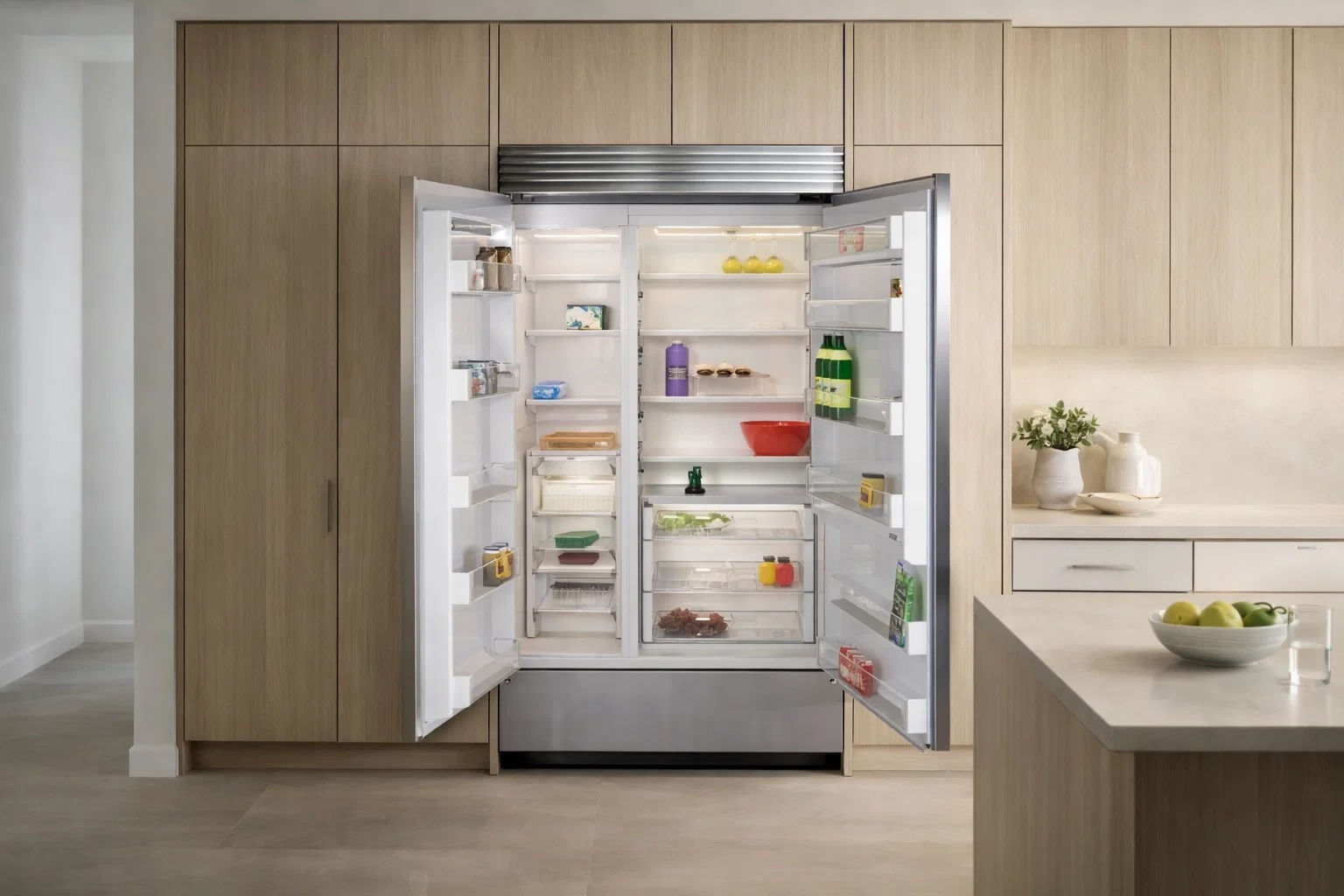
You swing open your Sub-Zero side-by-side and instead of that crisp, cold blast you get… room-temperature air.
Next thing you know there’s frost creeping across the back wall, milk’s going soft, and the compressor won’t shut up.
That’s the exact moment most Atlanta homeowners panic-search side by side door not sealing because the door simply isn’t closing tight anymore.
At Sub-Zero Techs, we see this every single day. A worn or torn gasket creates invisible gaps that let cold air pour out and humid Georgia air sneak in — classic Sub-Zero side by side door seal problems. The result? Your fridge side turns into a warm fridge, the freezer fights to keep up, and you end up with a side by side fridge losing cold air, random frost buildup, and condensation dripping between the doors. In short: leaking air that costs you groceries and money.
These side-by-side door seal problems almost never stay on one door. Sub-Zero engineered the system for balanced wear, so when one seal fails, the other usually follows within months.
Seeing frost, feeling a warm fridge, or watching your unit run nonstop? Don’t wait for spoiled food or a burned-out compressor.
Why Both Doors Matter Equally and What “Balanced Wear” Really Means
Sub-Zero didn’t design side-by-side models with a “main” door like most brands. Both doors carry the same load, open the same number of times, and seal the exact same amount of cold air. But how you use the doors dictates which one fails first. That’s why we constantly see both doors seal problems show up even if one side starts to fail first.
We call this side-by-side balanced wear.
When one gasket starts losing its grip, the other door instantly has to fight harder to keep the cold in. The compressor runs longer, humidity sneaks in, and within weeks the second door’s seal gives up too. In our Atlanta trucks, it’s rare to replace just one gasket — 8 out of 10 jobs end up being both sides.
Most common early warning signs we spot on service calls
- Light leaking out when you shine a flashlight inside with doors closed.
- Condensation or frost right along the center divider.
- The unit feels like it never shuts off.
- You can wiggle a dollar bill past the seal on either door without any tug.
Hinge Side vs Handle Side: The Hidden Wear Pattern
This is the part most people miss — and it’s critical on every Sub-Zero side-by-side.
- Hinge side (the edge closest to the hinges) takes the real beating. Every time the door swings, that section flexes and compresses thousands of times a year. That’s where side-by-side hinge-related seal failure almost always start — tiny cracks or flattening you can barely see until it’s too late.
- Handle side (magnetic strip opposite the hinges) mostly just sits there and seals. It usually stays perfect until the hinge side gap forces the whole gasket to twist.
Because of this, left door and right door don’t actually wear the same way, even though Sub-Zero wants balanced use.
Real-world pattern we see in the Classic series
Model | Door that usually fails first | Why |
CL4250S | Left door (refrigerator side) | Most families open the fresh-food side 5–10× more often → hinge side on left gets hammered |
CL4850S | Right door (freezer side on the right) | Freezer door is narrower and heavier → extra stress on right-hand hinges |
Older built-ins like BI-42S and BI-48S follow the same rule: whichever side you grab most wears its hinge edge fastest.
Bottom line: check the hinge side of both doors first. If you spot even a hairline gap there, the other door is probably only a few months behind.
Ready to stop the damage before both seals are toast?
Main Signs Your Sub-Zero Door Seal Is Shot
Here are the dead giveaways our techs spot the second we walk in the door:
- Fridge side feels lukewarm even when the display says 34 °F → classic warm fridge.
- Compressor never shuts off (runs 20–30 minutes straight) → losing cold air.
- Thick frost on the back wall or ice coating your frozen pizzas.
- Water droplets or sweat between the doors and down the center mullion.
- You feel a puff of warm air when you crack the door → straight-up leaking air.
- Electric bill jumped $20–$50 for no reason.
If two or more of these sound familiar, your side by side door not sealing is almost certainly the problem.
Sub-Zero Side-by-Side Models That Keep Us the Busiest in Atlanta
These are the units we roll out for gasket jobs week after week:
Model | Width | Typical age when seals fail | Where the gasket usually gives up first | What owners actually search when it happens |
550 | 36″ | 15–20 years | Bottom corners & hinge area | Replace gasket on 550, 550 not cooling |
561 | 36″ | 14–18 years | Bottom edge & middle of door | 561 door seal problem, 561 not cooling |
650 | 42″ | 12–17 years | Entire perimeter flattens out | 650 gasket replacement, 650 not cooling |
690 | 48″ | 10–15 years | Corners start cracking | 690 not cooling |
BI-42S | 42″ | 10–18 years | Hinge side collapses first | BI-42S gasket replacement, 42 inch door gasket |
BI-48S | 48″ | 8–16 years | Full perimeter, especially top & bottom | BI-48S door seal issue, BI-48S door seal failure, 48 inch door seal replacement |
648PRO | 48″ | 7–12 years | Whole gasket gets crushed from heavy doors | 648PRO door seal issues |
CL4250S | 48″ | 5–10 years | Left fresh-food door (hinge side takes the beating) | CL4250S door gasket issue, CL4250S left door seal |
CL4850S | 48″ | 5–10 years | Right freezer door (narrower & heavier) | CL4850S right door gasket |
Quick way to know if yours is on the list: open the fresh-food side and look at the rating plate on the ceiling or upper wall. If the model number matches any above and you’re seeing the symptoms, it’s gasket time.
How to Check Your Sub-Zero Door Seals in Under 2 Minutes (Dollar-Bill + Flashlight Tests)
Do these two quick checks tonight — takes 90 seconds total:
- Dollar-bill test. Close a dollar bill (or any thin piece of paper) in the door at 6–8 spots around each door. If you can pull it out with zero resistance anywhere → door gasket leak confirmed. A good seal grabs hard.
- Flashlight test. Put your phone flashlight inside, shut both doors in a dark room. Any light leaking out around the edges = cold air leaking out too.
Both tests failing? You’re officially dealing with a bad seal.
Step-by-Step Sub-Zero Door Seal Replacement

Yes, you can do it yourself, but 9 out of 10 DIY jobs we see end up with twisted gaskets or cracked door liners. Here’s the real-world process — short and honest:
Universal steps for every model door seal replacement
- Order genuine Sub-Zero gasket by exact model number (aftermarket ones shrink and fail in months).
- Unplug the fridge.
- Warm the old gasket with a hair dryer on low, then peel it out of the channel starting at the top corner.
- Clean the channel with rubbing alcohol.
- Start the new gasket at the top center, push it in by hand all the way around — never stretch it.
- Close the door a few times and check for even contact.
550 / 561 / 650 series gasket replacement
Remove the inner plastic liner (10–12 screws). Old gasket is glued + barbed — takes muscle. Most common DIY mistake: tearing the liner.
BI-42S and BI-48S
No screws — gasket is pressed into a dart channel. Needs a plastic trim tool so you don’t gouge the stainless. Hinge-side alignment is super picky.
CL4250S / CL4850S left & right doors
Left and right gaskets are different part numbers. Left door (fresh food) opens 5× more → usually fails first. Right door is heavier → hinge side compresses faster. Swap the wrong one and it’ll never seal flat.
648PRO
Commercial-weight doors. Gasket is twice as thick and the channel is metal-reinforced. Needs two people and a heat gun — not a weekend job.
When the Gasket Isn’t Actually the Problem
We’ve seen it hundreds of times: customer swears it’s the door seal, we run the dollar-bill test, and both gaskets grab like new. Yet the fridge is still warm and you’re getting 511 not, 550, 561 not cooling, or similar complaints.
Here are the real culprits we find most often when the seals are innocent:
- Evaporator coil in the fresh-food side completely iced over (failed defrost heater, defrost thermostat, or control board).
- Fresh-food evaporator fan dead or frozen solid (most common reason the fridge side hits 50 °F while freezer is −10 °F).
- Clogged defrost drain → ice block under the coil that kills airflow.
- Low refrigerant in the fresh-food circuit (slow leak).
- Bad temperature sensor or main control board lying to the system.
These are not DIY jobs. One wrong move and you’re looking at a $1,200–$2,500 bill instead of $650.
When It’s Time to Call a Experienced Sub-Zero Tech
Skip the guesswork and call us the minute you notice any of these:
- Seals pass the dollar-bill and flashlight tests but you still have warm spots or frost issues.
- You hear clicking every few minutes (possible relay or start device failure).
- The compressor is hot to the touch and running non-stop.
- Error codes on the display (Service light flashing, EC codes, etc.).
- Ice buildup behind the back panel in the freezer.
We’re highly trained, carry necessary parts and tools in the van, and fix 95 % of these on the first visit.
Don’t risk turning a $500 gasket call into a $2,500 compressor replacement.
FAQ
My Sub-Zero BI-48S freezer is fine, but the fridge side is warm. Is it really the door seal?
70 % of the time — yes. Check the 48 inch door seal replacement areas first (especially hinge side). If the dollar bill slides out easily, that’s your fix. If seals pass the test, we usually find an iced-over evaporator in the fresh-food side instead.
How often should I replace the gaskets on a 650 or 561?
Genuine Sub-Zero gaskets last 12–20 years in normal homes. We start seeing 650 gasket replacement and 561 door seal problem calls around year 14–16 in Atlanta’s humidity. Heavy-use homes (kids, teens) need them sooner.
Can I just buy a universal gasket on Amazon for my CL4250S?
Please don’t. The CL4250S left door seal and right door gasket are different part numbers and profiles. Aftermarket ones shrink, crack, and leave gaps within a year. We’ve replaced hundreds of those “bargain” gaskets under warranty.
My 648PRO doors are super heavy and the seals look squashed. Is that normal?
No — that’s classic 648PRO door seal issues. Those commercial-weight doors crush regular gaskets fast. Sub-Zero makes a thicker, reinforced version specifically for the 648PRO. We keep them on every truck.
I failed the dollar-bill test on my 550. Is this a DIY job or should I call you?
You can do the replace gasket on 550 yourself, but 8 out of 10 times we get called back because the new gasket is twisted or the inner liner cracked during removal. If you want it done once and done right the first time, give us a shout — most 550 not cooling gasket jobs are finished same-day for good.
