
We work inside Sub-Zero kitchens every day across Atlanta. These are not starter appliances. They are built-in Classic Series refrigerators designed to operate quietly, accurately, and for decades. More often, performance slips just enough for homeowners to notice.
The refrigerator feels warmer than it should.
The freezer still seems cold.
The control panel does not respond the way it used to.
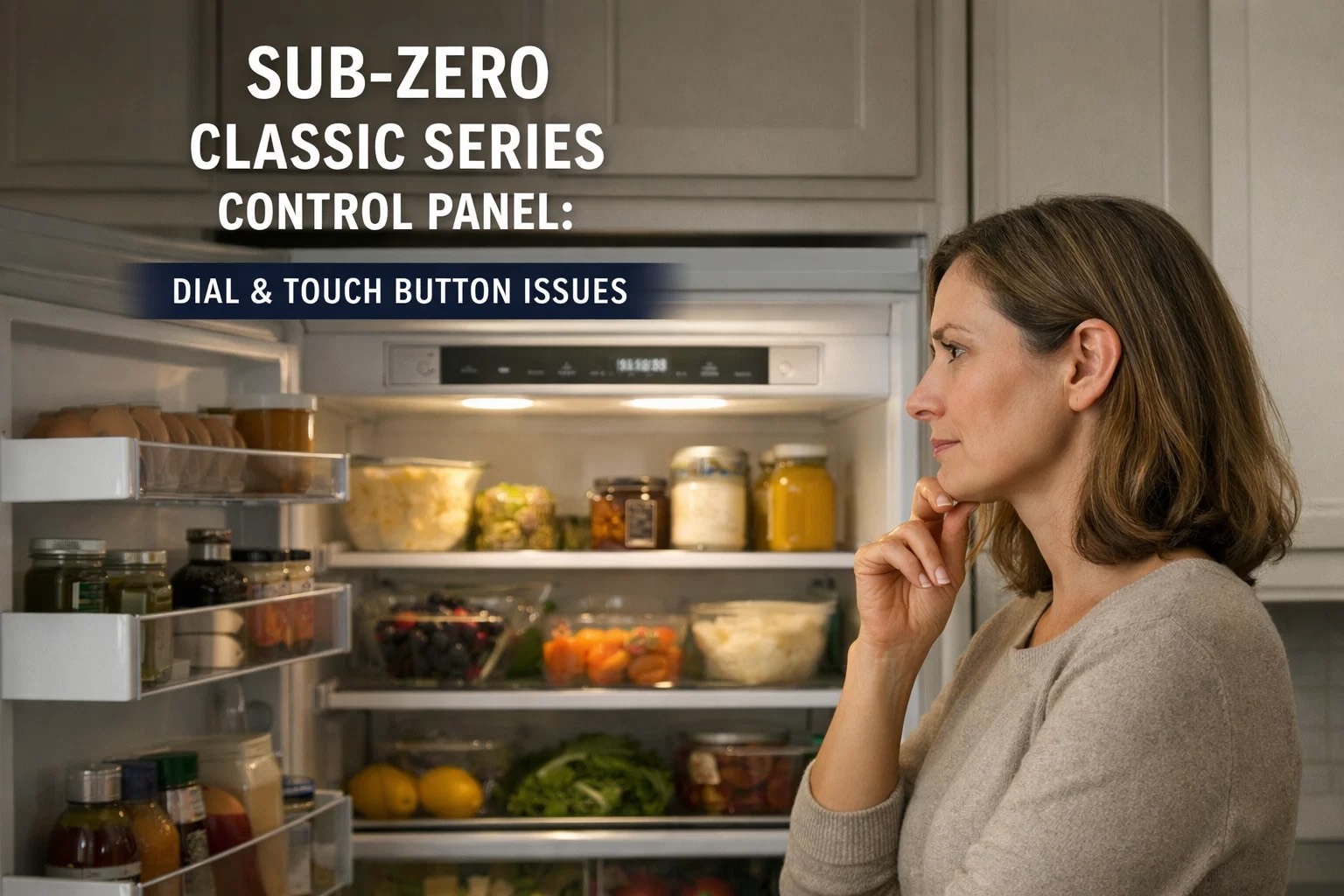
Our article focuses on one of the most common and misunderstood causes behind those complaints: electronic and control panel issues in Sub-Zero Classic Series refrigerators. From dial malfunctions in older units to touch button failures in newer models, control problems play a major role when a classic refrigerator is not cooling properly. Local help for this exact issue is available – see our Smyrna service page.
Why Control Panels Matter More Than Most People Realize
Sub-Zero Classic refrigerators do not rely on simple mechanical thermostats. Cooling is managed electronically. Sensors monitor internal conditions, and the control system decides when to run, how long to cool, and where cold air is directed.
When that system stops communicating accurately, the refrigerator does not shut down. It keeps running, just not precisely.
This is why homeowners ask:
- Why is my classic refrigerator warm
- Why does adjusting the controls not change anything
- Why is the fridge warm but the freezer cold
In many cases, the refrigerator is doing exactly what the control system tells it to do. The problem is that the instructions are no longer reliable.
Classic Refrigerator Not Cooling as Designed
A classic refrigerator not cooling rarely fails all at once. Performance usually declines gradually. Temperatures drift. Food does not stay fresh as long. Adjustments seem ineffective.
We see this pattern repeatedly in long-running Classic Series models, including 511, 550, 590, 661, and 700BR units. These refrigerators often continue operating, which makes the issue harder to identify. Fans run. Lights are on. The freezer still freezes.
From a service standpoint, this is a textbook classic series not cooling fix scenario tied to electronic control accuracy, not sealed system failure.
When the Fridge Is Warm but the Freezer Is Cold
One of the most common complaints we hear is that the refrigerator section struggles while the freezer remains stable.
This happens because the freezer receives priority cooling. The refrigerator compartment depends on precise airflow timing and control signals. When those signals degrade, the fridge section is usually affected first.
This condition, often described as a classic fridge warm but freezer cold, is strongly associated with control panel problems rather than mechanical breakdowns.

Touch Button Unresponsive in BI and Newer Classic Models
Later-generation Classic and BI-Series refrigerators use touch-sensitive control panels. They offer a clean, minimal look, but they rely on delicate internal components.
We frequently service:
- BI-36 button unresponsive complaints
- BI-48 touch button issues
- CL3650 control panel failures
- CL4850 touch control problems
Homeowners typically report that the panel lights up but certain buttons stop responding. Temperature changes may not register. Alarms may not silence.
These issues are rarely software-related. Over time, moisture, heat, and normal kitchen use wear down the touch membrane and internal connections. Once that happens, resets do not restore proper function.

Dial Malfunction in Older Classic Series Refrigerators
Earlier Classic Series models use rotary dials instead of touch controls. These systems are durable, but age affects precision.
We often diagnose BI-42 dial malfunction issues, as well as similar problems in older Classic refrigerators. The dial still turns and feels normal, but internally the signal no longer reaches the control board.
As a result, changing the setting does not change cooling behavior. This is a common explanation when homeowners say the classic not getting cold, even though the control appears correctly set.

Common Causes of Not Cooling in Classic Series Units
Based on long-term service experience, the most frequent common causes of not cooling in classic refrigerators tied to electronics include:
- Control board degradation
- Worn touch membranes
- Dial sensor drift
- Corroded ribbon connections
- Damage from electrical fluctuations
Because many Classic and BI-Series models share similar electronic architecture, bi-series not cooling complaints often mirror Classic Series symptoms.
Model Patterns We See Most Often
Rather than focusing on individual failures, we look at patterns across generations.
Model Group | Typical Control-Related Issue |
Early Classic (511, 550, 590) | Dial no longer regulating accurately |
Mid-generation Classic (661, 700BR) | Cooling drift tied to control signals |
BI-Series (BI-36, BI-42, BI-48) | Button or dial response problems |
Newer Classic (CL3650, CL4250, CL4850) | Touch control inconsistency |
Different hardware, similar outcome. Cooling performance declines as electronic accuracy fades.
How to Troubleshoot Classic Not Cooling Symptoms
We do not recommend attempting electronic repairs without proper tools. However, certain signs strongly point toward a control issue:
- Temperature adjustments do not affect cooling
- Buttons or dials respond inconsistently
- Refrigerator section warms while freezer remains cold
- Performance improves briefly, then declines again
For homeowners searching how to troubleshoot classic not cooling, these symptoms usually indicate that professional diagnostics are needed.

Why Classic Control Panel Repair Requires Specialization
Sub-Zero control systems are model-specific and tightly calibrated. Incorrect repairs can lead to temperature inaccuracies, repeat failures, or unnecessary part replacements.
Proper classic control panel repair includes:
- Model-specific electronic diagnostics
- Verification of sensor input and output
- Board-level testing
- Calibration after repair
This is why homeowners searching for the best repair service for classic Sub-Zero refrigerators typically choose specialists rather than general appliance companies.
Fixing a Warm Fridge in the Classic Series
When addressing a fixing warm fridge classic series issue, the goal is not a temporary improvement. It is restoring accurate control so the refrigerator performs the way it was designed to.
In many cases, correcting the electronic issue resolves cooling problems without replacing major mechanical components.
The Bottom Line
Sub-Zero Classic Series refrigerators are built for precision. When cooling problems appear, the cause is often subtle and electronic rather than mechanical. Control panel issues rarely stop a refrigerator outright. Instead, they quietly reduce performance over time.
Whether the problem presents as unresponsive buttons, a dial that no longer regulates temperature, or a refrigerator section that stays warm, the underlying issue is usually the same. The control system is no longer managing cooling accurately.
Addressed early, these problems are manageable. Ignored, they often lead to larger and more expensive repairs.
FAQ
Why is my Sub-Zero Classic refrigerator warm but the freezer is cold?
This usually points to a control or airflow issue. The freezer receives priority cooling, while the refrigerator compartment depends on precise electronic timing.
Can control panel problems cause a Classic refrigerator not cooling?
Yes. Control panel and control board issues are among the most common reasons Classic Series refrigerators lose cooling accuracy while still running.
Should the control panel or control board be replaced?
That depends on the model and failure point. Some issues involve the touch membrane or dial assembly, while others involve the main board. Diagnostics are essential before replacing parts.
Is it safe to keep using the refrigerator if cooling is inconsistent?
Short-term use is usually safe, but inconsistent cooling can affect food safety and place added strain on other components.
